
STONKEX is the token associated with The Stonks Exchange platform on Base, with the official contract address 0x5ab000ff9B9FfE0349CE5ffA5fD86f217C3680F5. The Stonks Exchange allows users to launch Meme Tokens and pair them with B20 assets—such as Coinbase Tokenized Stocks—in Uniswap V3 liquidity pools. STONKEX is not Coinbase stock, not an official Coinbase platform coin, and not a representation of equity in any public company.
What makes STONKEX worth studying is how the platform connects trading volume → fees → buyback → burn: each applicable swap incurs a 1% fee, of which 0.7% goes to the creator and 0.3% to the platform. Under current protocol rules, 80% of the platform’s share is used to buy and burn STONKEX in the open market, while 20% goes to operational revenue. So the real question isn’t how hot the “stock meme” narrative is—it’s whether platform trading can generate sustainable fees and whether buyback scale can keep pace with valuation growth.
Risk Disclaimer: Data in this article is current as of September 7, 2026. This is for project research and educational purposes only—not investment advice, performance guarantees, or trading recommendations. STONKEX has been live for a short time, exhibits extreme price volatility, and involves risks related to memes, DeFi, smart contracts, and tokenized securities. You may lose your entire principal.
Core Takeaways: 6 Things to Know Before Buying STONKEX
- STONKEX runs on Base (Chain ID 8453). Always verify the full contract address—never rely on the ticker alone.
- STONKEX is not a Coinbase-issued tokenized stock, nor is it Coinbase company stock.
- The Stonks Exchange differentiates itself by letting new Meme Tokens use B20 stock tokens as quote assets.
- Platform-launched tokens have fixed supply and permanently locked LP, but “liquidity locked” does not equal price safety.
- The fee distribution and buyback/burn contracts are public; on-chain data shows the Fee Splitter transferring STONKEX to the burn address.
- The project is extremely early—launch counts, volume, and price spikes alone do not prove product-market fit.
You can check STONKEX real-time price and STONKEX/USDT market depth, but live price is only a starting point, not a valuation conclusion.
1. What is STONKEX? Meme Coin, Platform Token, or Launchpad Token?
STONKEX’s full name is The Stonks Exchange, running on Base. The official website marks the following as the sole official STONKEX contract:
0x5ab000ff9B9FfE0349CE5ffA5fD86f217C3680F5
From a market-label perspective, it carries meme and “stonks” internet-culture traits. From a product perspective, it’s the ecosystem token of The Stonks Exchange. From a value-capture perspective, it’s closer to a launchpad token with a buyback & burn mechanism.
So calling STONKEX simply a “meme coin” misses the platform-revenue logic; calling it a “stock token” is outright wrong. A more accurate classification is:
A Base-native memestock launchpad ecosystem token whose value depends primarily on platform adoption, fees, and buyback/burn execution.
Why did some sources list STONKEX as BSC?
A HiBT listing announcement once showed “BSC” in the network field, but the same announcement provided a BaseScan link. The Stonks Exchange official site clearly states “Live on Base · chain 8453,” and Coinbase price data also identifies the contract as a Base asset. This article cross-validates using on-chain data, the official website, and block explorers, confirming STONKEX is on Base.
This is a useful rule when researching new coins: exchange announcements may have typos—always verify network and contract using at least the project’s official site, a block explorer, and one independent source.
2. What is The Stonks Exchange, and Why Pair Meme Coins with Stocks?
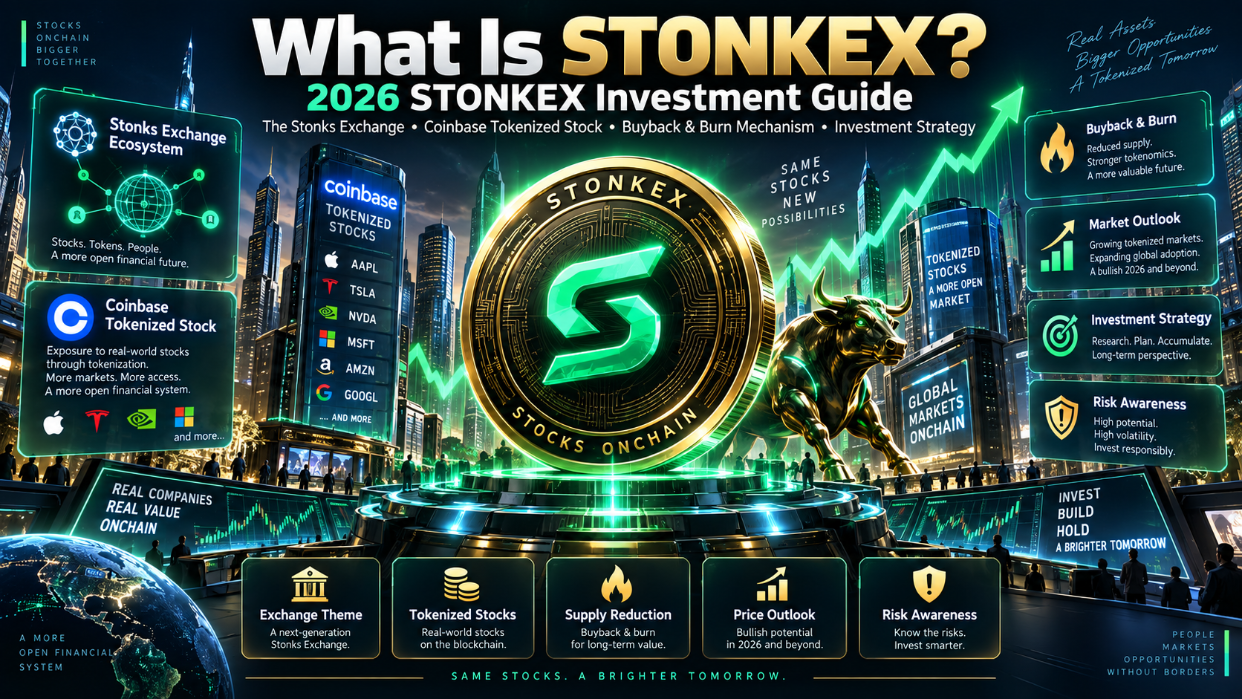
A typical meme launchpad usually works like this: create a token, set supply, establish a pool with ETH or a stablecoin, and let the market discover price.
The Stonks Exchange does something different: it uses tokenized stocks as quote assets. Users can create markets like CAT/NVDA, DOG/AAPL—not just CAT/USDC or DOG/WETH.
“CAT/NVDA” means CAT is priced in a verified NVIDIA B20 token—it does not mean CAT grants NVIDIA equity. If CAT trades at 0.002 NVDA and the NVDA Token references a $200 stock price, CAT’s theoretical USD price is:
0.002 × $200 = $0.40
CAT’s USD price can move due to two layers: the CAT/NVDA exchange rate, and the underlying NVDA stock price. Traders are expressing not just “what is this meme worth in dollars,” but “what is this meme worth relative to a specific stock.”
This sits at the intersection of meme culture, tokenized equity, and DeFi. But innovation does not equal proven demand. The real question: will users stick with stock-quoted pairs long‑term, or will they ultimately prefer simpler USDC/WETH pairs?
3. What are Coinbase Tokenized Stocks and B20?
On August 24, 2026, Base announced that Coinbase Tokenized Stocks are natively available on Base. According to official materials, these assets are 1:1 backed by real U.S. stocks held by regulated custodians, available to eligible non‑U.S. users, and usable in self‑custodial wallets and Base DeFi ecosystems.
This does not mean Base issues or guarantees every third‑party project using these assets. Base is an open network; The Stonks Exchange is a third‑party application; STONKEX is that app’s associated token. The relationship must be clearly distinguished:
- Coinbase handles the issuance structure for tokenized stocks.
- Base provides the underlying blockchain network.
- The Stonks Exchange uses these assets to build launchpad markets.
- STONKEX captures the platform fee and buyback narrative.
What problems does B20 solve?
Base engineering documentation shows that B20 is an RWA‑oriented token standard that handles stock splits, dividend reinvestment, compliance, freezes, seizures, and other real‑world corporate actions.
The most important element is the Multiplier. A B20 token is not permanently equal to one share: splits or net dividend reinvestment can change the Multiplier, so valuations and swaps must read the current Multiplier—never assume “1 token = 1 share” forever.
Minting and redeeming Coinbase Tokenized Stocks is done by KYC’d Authorized Participants. Regular users acquire the on‑chain assets and their rights structures on secondary markets. Availability varies by region, platform, and asset—always refer to the official Base verified asset list and product terms.
Why is looking only at the ticker dangerous?
Base is permissionless—anyone can create a token with the same name or logo. When verifying stock tokens or STONKEX, always check the official contract address. The letters “NVDA” or “STONKEX” alone prove nothing.
4. What is the Actual Relationship Between STONKEX and Coinbase?
STONKEX is not an official Coinbase token, nor is it a tokenized share of Coinbase Global (NASDAQ: COIN).
The Stonks Exchange uses Coinbase Tokenized Stocks as quote assets—that’s a third‑party DeFi integration. Base official materials also explicitly state that the appearance of third‑party protocols, incentives, or apps does not constitute endorsement, partnership guarantees, or risk assurance from Base or Coinbase.
Therefore, none of the following statements should serve as investment rationale:
- “STONKEX is Coinbase’s platform coin.”
- “Coinbase will support STONKEX’s price.”
- “Using B20 assets means Coinbase invested in the project.”
- “Base listing a project means it has passed official investment review.”
STONKEX investors bear the risks of The Stonks Exchange platform and the token itself—not direct exposure to Coinbase stock.
5. How is a Token Launched on The Stonks Exchange?
Step 1: Deploy Fixed‑Supply Token
According to the project’s mechanics page, platform‑launched tokens have a fixed supply of 1 billion, 18 decimals, and are designed with no mint, no pause, no blacklist, no owner. Note: this describes the platform’s token template—do not automatically extend it to every meme or stock token on Base.
Step 2: Choose a B20 Stock Quote Asset
The creator selects a supported asset like NVDA, AAPL, or COIN from the Quote Registry. The platform uses Chainlink price feeds to set the initial price anchor at launch, aiming for comparable initial valuations across projects with different stock quotes.
Step 3: Create a Single‑Sided Uniswap V3 Position
The entire token supply is placed into a Uniswap V3 1% fee tier single‑sided LP position. At launch, the position is 100% new token and 0% stock token; buyers provide quote assets in exchange for the new token, and the price moves along the V3 range.
This is not a traditional bonding curve—it’s price discovery through Uniswap V3 concentrated liquidity.
Step 4: LP NFT Goes into the Fee Locker
The LP Position NFT is transferred to the Fee Locker. The public contract design does not provide decreaseLiquidity, burn, NFT transfer, or approval paths; upgrade functions revert. So LP principal is designed to be irretrievable—only swap fees can be collected.
Step 5: Swap Fees Flow to Creator and Platform
Each swap incurs a 1% fee: 0.7% goes to the Creator, 0.3% goes to the Platform Fee Splitter, which then allocates to operational revenue and STONKEX buyback/burn.
6. Does “Permanent LP Lock” Solve Rug Pull?
Permanent LP lock reduces the classic risk of the creator abruptly withdrawing liquidity principal—this is an important design improvement over typical anonymous meme launches.
But it only addresses one risk dimension—it does not guarantee asset safety.
Even with LP locked, the following can still happen:
- Token price falls near zero.
- Buyers disappear, depth dries up.
- Smart contract or router vulnerabilities emerge.
- B20 quote assets are restricted, suspended, or lack liquidity.
- Chainlink feeds expire or markets close, causing pricing errors.
- Front‑end, aggregator, or wallet interactions have security issues.
- Large trades suffer severe slippage due to concentrated liquidity ranges.
Liquidity Locked ≠ Investment Safe.
Permanent lock also carries opportunity cost: if trading demand vanishes, the locked principal cannot be migrated to more efficient pools, nor does it guarantee sufficient bilateral assets remain in the pool.
7. STONKEX Tokenomics: Where Does the 1% Fee Actually Go?
Under current official rules, each applicable swap’s 1% fee is split as follows:
- 0.7% of notional → Token Creator
- 0.3% of notional → Platform
- 80% of the platform’s 0.3% share → used to buy and burn STONKEX
- Remaining 20% → Operator Revenue
In terms of total volume, that theoretically means:
- 0.24% of volume → STONKEX buyback & burn
- 0.06% of volume → operational revenue
This is the STONKEX Buyback Flywheel:
More launches → more active markets → higher platform volume → more swap fees → more platform revenue → larger STONKEX buy pressure → more tokens burned.
“May improve supply/demand” is a reasonable inference; “will inevitably push price up” is not. Actual buyback results depend on market valuation, sell pressure, execution price, and whether platform trading persists.
Are protocol parameters completely immutable?
Not entirely. The official docs show operators can adjust fee splits with a 24‑hour on‑chain delay, subject to a hard cap ensuring creators get at least 20%. Operators cannot withdraw locked LP, mint additional platform‑template tokens, or upgrade the Locker—but they do retain admin rights over stock lists, price feeds, and some fee parameters.
Investors should study both what the contract cannot do and what operators still can do.
8. If the Platform Does $10M in Daily Volume, How Much Buy Pressure Does That Create?
Assume all $10M volume is subject to the above fees, fully collected and executed per rules:
- Platform Volume: $10,000,000
- 1% Total Swap Fee: $100,000
- Creator 0.7%: $70,000
- Platform 0.3%: $30,000
- 80% of Platform Fee for buyback: $24,000
- Operator 20%: $6,000
So $10M platform volume does not equal $10M STONKEX buy pressure—the theoretical buyback is about $24,000.
Formula:
Theoretical STONKEX Buyback = Applicable Platform Volume × 1% × 30% × 80%
i.e. ``
This is a simplified example based on protocol rates—it does not reflect actual daily settlements, collection, routing losses, or buyback results. Also, distinguish STONKEX trading volume itself from total volume across all The Stonks Exchange markets—only the latter is the foundation for platform fee generation.
9. Is the STONKEX Buyback & Burn Real? What Does On‑Chain Data Show?
The project’s public StonkFeeSplitter address is:
0xfBC9eE130f1CFeeb192b18CF1202865d757FA680
Official docs state this contract receives the platform’s 0.3% fee share; the Keeper withdraws 20% as operational revenue and uses the remaining 80% to buy STONKEX on the market and send it to the burn address.
As of September 7, 2026, Base chain RPC verification shows:
- STONKEX contract
totalSupply()still returns 1,000,000,000. - The
0x000000000000000000000000000000000000dEaDaddress holds approximately 82,123,095.96 STONKEX. - Net of that burn address, effective uncirculated supply ≈ 917,876,904.04.
- Transfer events from the Fee Splitter to
0x…dEaDare observable.
For example, a transaction around 2026‑09‑07 05:11:41 UTC sent ~4,273.16 STONKEX from the Fee Splitter to the dead address. Tx hash:
``
This proves that “Fee Splitter sends tokens to Dead Address” is a real on‑chain action, not just website hype.
Why does total supply still show 1B while burned exceeds 82M?
Because the current approach sends tokens to the公认 unusable Dead Address, not calling a burn function that reduces ERC‑20 totalSupply(). So you see two numbers:
- Nominal total supply: 1B
- Effective supply after excluding Dead Address: ~917.9M
Some price trackers still calculate circulating supply and market cap using 1B—they may not deduct the dead address. So when researching STONKEX supply, never copy‑paste tracker numbers blindly; check both totalSupply() and Dead Address balance.
This verification confirms the burn path and results, but it does not trace all 82M+ tokens back to each platform fee collection. To prove cumulative burns came entirely from protocol revenue, you’d need a full audit of buyback input assets, swap paths, and all historical transactions.
10. How Do You Judge Whether the Buyback Burn Matters for Valuation?
Looking only at burn quantity is insufficient. At minimum, track four metrics.
1. Platform Volume
Volume across all The Stonks Exchange launch markets—not STONKEX/USDT or STONKEX/WETH volume alone.
2. Platform Fees
Actual collected fees, not theoretical rates multiplied by raw wash‑traded volume.
3. Buyback Amount
Value of quote assets used to purchase STONKEX. At lower token prices, the same capital buys and burns more tokens; at higher prices, fewer tokens.
4. Buyback Yield
Use this for valuation comparison:
Buyback Yield = Actual buyback amount over trailing 12 months ÷ Current STONKEX market cap
If the project has less than 12 months of history, show 7‑day or 30‑day yield—but never annualize a few days of blow‑off volume.
A high buyback yield is not an automatic buy signal—it could come from a very low market cap or unsustainable short‑term volume. Always cross‑check user retention, trading concentration, and revenue duration.
11. Does The Stonks Exchange Have Real Users Yet?
A snapshot of the project’s homepage on September 7 showed roughly 242 Coins, 186 “This Week” projects, and 103 Creators. That suggests high initial launch activity, but it does not prove platform success.
At least four questions remain:
- How many of these creators are distinct individuals vs. one person controlling multiple wallets?
- How many of the 242 tokens still have trading after 24 hours and 7 days?
- Is volume concentrated in a handful of top tokens?
- How much volume comes from stock‑paired markets vs. STONKEX itself?
Launch count measures supply; active traders and sustained volume measure demand. A large number of zero‑volume tokens may only indicate low creation cost, not product‑market fit.
Since homepage data is front‑end fetched from the chain, always re‑open The Stonks Exchange homepage to verify these dynamic numbers before referencing them.
12. Stock‑Paired Pairs: Long‑Term Demand or Short‑Term RWA Hype?
Stock tokens as quote assets offer three potential values:
- Let traders express views on “meme vs. stock” price relationships.
- Give B20 assets new on‑chain trading and liquidity venues.
- Bridge meme users, RWA users, and Base DeFi applications.
But they also add complexity:
- B20 Multiplier changes with dividends and splits.
- On‑chain AMMs may trade when U.S. stock markets are closed.
- Quote assets can trade at premiums, discounts, or with thin liquidity.
- B20 assets have regional eligibility, compliance controls, and issuance‑structure risks.
- Users must understand both meme‑token volatility and underlying stock volatility.
The Stonks Exchange stock page showed 13 Listed Quote Assets at the time of capture, but the “On‑chain markets” dynamic field briefly showed 0—indicating the page read state or actual liquidity still needs verification. The product can create single‑sided pools before the quoted stock has a live circulating supply, but real buying and selling still require the other side of the asset and usable routes.
So allowed to create markets and markets are actually tradable are two different things. Investors should focus on stock‑paired volume, not just how many stock tickers are listed on the site.
13. Why Did STONKEX Gain Attention in September 2026?
Recent attention around STONKEX comes from five catalysts:
- Coinbase Tokenized Stocks natively launched on Base on August 24.
- The Base ecosystem began building trading, lending, and structured products around B20.
- The Stonks Exchange combines stock tokens with a meme launchpad.
- STONKEX is designed as the platform’s buyback/burn asset.
- More CeFi and DeFi on‑ramps improve accessibility.
As of a September 7, 2026 CoinGecko snapshot, STONKEX price was ~0.019, circulating market cap ~18.66M, 24h volume ~9.98M, and +401% over 7 days; all‑time high ~0.032. Data also fluctuated within the same day, confirming it’s in a high‑volatility price‑discovery phase. Use the CoinGecko live page as the updated reference—don’t hard‑code the snapshot above.
HiBT added a STONKEX/USDT trading pair around September 7—this is a liquidity event, but a listing does not equal platform revenue growth or an endorsement from the exchange.
14. Is STONKEX Expensive or Cheap Now? Always Put Market Cap Next to Platform Fees
“STONKEX is only $0.019, so it’s cheap” is a flawed valuation method. At 1B nominal supply, $0.019 already implies ~$19M FDV; if trackers don’t deduct the dead address, Market Cap may be close to FDV.
Better valuation uses:
- Market Cap vs. effective uncirculated supply
- Weekly and monthly Platform Volume
- Actual Platform Fees
- Actual Buyback Amount
- Buyback Yield
- Growth in active markets, traders, and creators
- Stock‑paired volume share
For example, if annualized actual buyback is $2M and market cap is $20M, the simplified Buyback Yield is ~10%. But if that $2M is merely a one‑week number extrapolated linearly, the conclusion is highly unreliable.
The biggest red flag: STONKEX market cap rises 500% while platform effective volume grows only 20%. That means valuation is outpacing fundamentals—even if the platform continues growing, price may still correct due to excessive expectations.
15. HIBT STONKEX Six‑Factor Analysis Framework
Factor 1: Launch Activity
Track weekly launches, unique creators, repeat‑creator rates, and trends. Launch growth only measures supply growth.
Factor 2: Active Trading
Check whether new tokens have both buyers and sellers after 24h, 7d, and 30d—avoid counting zero‑volume projects as active markets.
Factor 3: Platform Volume
Aggregate volume across all The Stonks Exchange markets, and break down stock‑quoted, WETH‑quoted, and STONKEX‑only volume.
Factor 4: Fee Generation
Examine actual Creator and Platform fees collected by the Fee Locker—confirm whether theoretical rates translate into cash flow.
Factor 5: Buyback & Burn
Track quote assets received by the Fee Splitter, market swaps, and transfers to the Dead Address; calculate both buyback capital and burn quantity.
Factor 6: Valuation
Compare Market Cap, Buyback Yield, platform growth rates, and competitors to judge whether price already discounts future expectations.
Ratings can be Strong, Neutral, or Weak—but never write “9.6/10 Strong Buy.” The framework’s purpose is to weigh evidence, not replace personal risk tolerance.
16. STONKEX Price Scenarios: Bull, Base, and Bear
Investors can review STONKEX price prediction trends, but for a token live less than a month, fixed forecasts like “$1 by 2030” lack a credible foundation. A more logical approach is to set verifiable conditions for each direction.
Bull Case: Stock‑Meme Launchpad Finds Real Market Fit
Optimistic signals: sustained growth in unique creators and active traders; rising stock‑paired volume share; Coinbase adding more B20 assets; growing platform fees; expanding buyback and burn; long‑term RWA user retention; valuation growth not persistently outpacing revenue growth.
Base Case: Product Retains a Niche, Hype Normalizes
Neutral scenario: launches decline from the initial spike; a handful of active markets remain; volume stabilizes; buyback continues but at modest scale; STONKEX trades in a wide range, with valuation following platform data more than narrative expansion.
Bear Case: Price Rises but the Product Flywheel Stalls
Pessimistic signals: creators and active markets decline consecutively; many tokens see zero volume; stock pairs remain unused; volume concentrates on STONKEX itself; platform fees and buyback shrink; Dead Address balance stops growing; B20 liquidity development disappoints; a stronger Base launchpad emerges; overall crypto enters risk‑off mode.
When price hits new highs while Platform Volume, Fees, Buyback, and Burn all decline, the model must be redone.
17. Beginners, Short‑Term Traders, and Long‑Term Investors Should Use Different Approaches
Beginners: Verify Identity Before Price
Complete four checks: Network = Base; Contract = 0x5ab0…80F5; understand STONKEX is not Coinbase stock; understand stock pairs do not grant equity rights.
Start with a small observation position to learn price, liquidity, and platform data—don’t mistake “permanent LP lock” and “auto‑buyback” for low risk.
Short‑Term Traders: Trade Momentum, But Write Down Invalidation Rules
Monitor volume, liquidity, holder growth, listing events, Base B20 sentiment, and volume confirmation after breakouts. Before entering, clearly define Entry, Stop, Exit, and Invalidation Condition.
If your trading thesis is based on listing and RWA hype, then rapid volume contraction, price falling back to pre‑event ranges, or cooling B20 sentiment should all trigger reassessment.
Long‑Term Investors: Watch Platform Data Weekly, Not Just Candlesticks
Build a weekly dashboard: Active Coins, Creators, Platform Volume, Platform Fees, Buyback, Burn, Dead Address Balance, and STONKEX Market Cap. Weeks or months of data validate the business model better than a one‑day spike.
Scaling in (e.g., 25%‑25%‑25%‑25%) reduces single‑point price risk but does not eliminate project‑failure risk. Even with a laddered approach, re‑check fundamentals before each add—never mechanically buy dips.
18. Why Can’t You Apply BTC/ETH Long‑Term Logic to STONKEX?
BTC’s long‑term value is typically analyzed via scarcity, network effects, monetary properties, and institutional demand—you can cross‑reference BTC price prediction and market cycles for broader risk appetite.
ETH can be studied through blockspace, gas, stablecoins, DeFi, staking, and network activity—ETH price prediction and Ethereum trends reflect Ethereum ecosystem and crypto liquidity more broadly.
STONKEX, however, is highly dependent on a single early‑stage application. Its core variables are Platform Volume, Fees, Buyback, and Base Tokenized Stock adoption. BTC or ETH rallies may boost overall risk sentiment, but they do not automatically bring users and fees to The Stonks Exchange.
STONKEX has more quantifiable tokenomics than a pure meme, but it also carries significant single‑product and early‑platform risks.
19. The 10 Biggest Risks for STONKEX
- Platform Risk – STONKEX depends heavily on The Stonks Exchange alone.
- Product‑Market‑Fit Risk – Users may not stick with “stock‑priced memes” long‑term.
- Volume Risk – Without sustained trading, there are no fees or buyback funds.
- Buyback Sustainability Risk – Buyback intensity varies with revenue; fee rules are not entirely immutable.
- Valuation Risk – Price can price in years of growth in a matter of days.
- Smart Contract Risk – Launcher, Locker, Registry, Router, and Fee Splitter all expand attack surfaces; the official site explicitly states launched tokens are unaudited.
- Tokenized Stock Risk – B20 assets themselves have liquidity, issuer, Multiplier, market‑hours, and compliance risks.
- Regulatory Risk – Coinbase Tokenized Stocks are only for eligible non‑U.S. regions; eligibility and transfer policies may change.
- Impersonation Risk – Fake tokens using STONK, STONKEX, or stock tickers are common—always verify the contract.
- Early‑Stage Data Risk – The project’s history is only weeks old; any revenue annualization, user retention, or price prediction is extremely unstable.
20. What’s the Difference Between STONKEX, STONK, and STONKBROKER?
These three names are very similar but are not the same project.
- STONKEX runs on Base, core project is The Stonks Exchange, focused on B20 stock pairs, platform fees, and buyback & burn.
- STONK runs on Solana, corresponds to StonkFun—research its own launchpad revenue and burn mechanics separately.
- STONKBROKER is yet another independent ecosystem asset—verify network, contract, and tokenomics individually.
Never assume they share teams, revenue, liquidity, or official relationships just because the name contains “STONK.” The full contract address is the first step to distinguishing them.
21. Why Can’t You Use the Same Framework for STONKEX, BONER, and ROBINCAT?
BONER leans more toward meme and stock‑token narratives—analysis focuses on attention, HIMS ties, liquidity, and holder distribution. STONKEX adds a layer of platform trading, fee capture, and buyback value.
ROBINCAT involves community memes and reward narratives—the most important question is where the reward funding comes from. For STONKEX, you track where buyback funds come from and whether they are actually executed.
All three share one research principle:
Whenever a token touts “rewards, dividends, buybacks, or burns,” the first step is not to calculate yield—it’s to find the source of funds.
Similar stock‑related themes do not mean identical value‑capture mechanisms. Meme attention, reward distribution, and platform buyback demand different valuation frameworks.
22. How to Buy STONKEX – 12 Pre‑Trade Checks
STONKEX/USDT means you quote and settle STONKEX in USDT. The typical process: register/sign in to a supporting platform, prepare USDT, search for STONKEX/USDT, verify the asset, and place a limit or market order.
Before entering, verify each of these:
- Network – Base?
- Contract –
0x5ab000ff9B9FfE0349CE5ffA5fD86f217C3680F5? - Market Cap – What valuation is the market already pricing?
- Effective Supply – Dead Address deducted?
- Liquidity – How much slippage for a large exit?
- 24h Volume – Is STONKEX’s own momentum sustained?
- Active Coins – Do launched tokens still trade?
- Active Creators – Is there independent creator growth?
- Platform Volume – Real usage of the core product?
- Platform Fees – Actual fees collected?
- Buyback – Is Fee Splitter consistently buying?
- Burn – Is Dead Address balance growing?
The four most critical metrics: Platform Volume → Fees → Buyback → Burn. Price should be examined after identity, liquidity, and value‑chain checks.
23. Frequently Asked Questions About STONKEX
What coin is STONKEX?
STONKEX is the token associated with The Stonks Exchange on Base, with its primary value narrative tied to platform trading fees, buybacks, and burns.
What is The Stonks Exchange?
It’s a Base launchpad that allows users to issue tokens and use B20 tokenized stocks as quote assets.
Which chain does STONKEX run on?
Base, Chain ID 8453. Some announcements have incorrectly labeled it as BSC—always rely on the official site and on‑chain contract.
What is the STONKEX contract address?
Official address: 0x5ab000ff9B9FfE0349CE5ffA5fD86f217C3680F5.
Is STONKEX an official Coinbase token?
No. The Stonks Exchange is a third‑party app on Base; using Coinbase Tokenized Stocks does not imply Coinbase endorsement.
Does buying STONKEX equal buying Coinbase stock?
No. STONKEX is not COIN stock and provides no Coinbase shareholder rights.
What is a B20 stock token?
B20 is a Base‑native RWA token standard that handles stock splits, dividends, compliance policies, and corporate actions.
Does permanent LP lock mean no risk?
No. It mainly reduces pool‑withdrawal risk—it cannot eliminate price, contract, quote‑asset, liquidity, or regulatory risks.
Is the STONKEX buyback & burn real?
The Fee Splitter and rules are public; on‑chain transfers from that contract to the Dead Address are observable. A full audit of cumulative funding sources is still needed.
How much has STONKEX burned so far?
As of the September 7, 2026 query, the Dead Address held 82.12M STONKEX, or 8.21% of nominal 1B supply. This number changes continuously.
Are STONKEX and STONK the same coin?
No. STONKEX is on Base and corresponds to The Stonks Exchange; STONK is on Solana and corresponds to StonkFun.
Is STONKEX worth long‑term investment?
That depends on whether stock‑paired markets build real users, whether Platform Fees sustain, whether Buyback executes, and whether current valuation is reasonable. A few weeks of data cannot prove long‑term value.
How to view STONKEX price predictions?
Use Bull, Base, and Bear scenarios, and re‑forecast whenever Platform Volume, Fees, Buyback, Burn, or Market Cap changes materially.
24. Conclusion: The Key to STONKEX Is Not “Stock Meme” – It’s Whether Trading Volume Converts into Real Buybacks
What makes STONKEX worth studying is that The Stonks Exchange attempts to combine Coinbase B20 tokenized stocks with a meme launchpad and establish a volume → fees → STONKEX buyback → Dead Address burn value‑capture mechanism.
What we can verify so far: the project runs on Base; contracts for Launcher, Fee Locker, and Fee Splitter are public; the fee rate is 1% with 0.3% to the platform; the Fee Splitter has indeed sent STONKEX to the Dead Address; as of Sept 7, the burn address holds ~82.12M tokens.
What remains unproven over the long term: whether stock‑paired pairs are genuinely useful to users; whether launched projects stay active; whether Platform Volume and Fees survive the initial hype cycle; and whether the rapidly expanding market valuation is reasonable.
So, instead of starting with “how high can it go,” research STONKEX in this order:
Real Creator growth → Active market growth → Stock‑paired Volume rise → Platform Fees increase → Buyback expansion → Dead Address balance growth → Valuation still aligned with data.
If any link in that chain stalls consistently, the long‑term investment thesis needs a rethink. For STONKEX, the narrative draws attention, platform trading generates revenue, on‑chain buybacks verify value capture, and valuation determines whether investors are overpaying for those expectations.