
AXIS is the native token issued by Axis Robotics on the Base network. Axis Robotics is trying to solve the data bottleneck in Physical AI—that is, embodied AI and robot model training: ordinary users can remotely operate simulated robots through a browser to generate action trajectories; the platform then replays, quality-checks, cleans, and processes these trajectories for training, and records part of the data provenance on-chain.
This is a direction worth researching, but my investment conclusion will not automatically turn bullish just because “robotics + AI + crypto” are three hot labels.
As of October 22, 2026, AXIS has completed its TGE and has entered markets including HIBT, Bitget, Upbit, HTX, and Uniswap on Base. The real question is no longer “Can I buy AXIS?” but rather: Can Axis Robotics’ product adoption create sustained demand for AXIS, and can that demand absorb future token releases and the current valuation?
My judgment is: Axis Robotics has a clearer product and research foundation than an average AI concept token, but AXIS remains an early-stage, highly volatile risk asset whose value capture has yet to be validated. Until three things—product commercialization, actual token demand, and unlock supply—are all in place at the same time, it is not suitable to make a heavy long-term bet based solely on the Physical AI narrative.
Data note: Market data in this article was captured on October 22, 2026. Price, volume, and circulating supply statistics change quickly in the early post-listing period, and should be re-verified before publication and before trading. This article is for information and research only and does not constitute investment advice.
Key Takeaways: 8 Things to Know Before Researching AXIS
- This article discusses AXIS from Axis Robotics, not the historical AXIS token from the logistics project LaneAxis.
- The official Axis Robotics contract is on Base:
0x5bE75e3b0aFf5D1A042A5363Ae36AcB1d6d755ea. - AXIS has a fixed total supply of 1 billion tokens, with an official TGE initial circulating supply of 165 million tokens, or 16.5%.
- The community sale price was $0.10, corresponding to a $100 million FDV; after launch, the market price briefly approached $0.30, corresponding to an FDV of nearly $300 million.
- Axis Points are not a tradable token, and there is no officially promised fixed conversion ratio; they cannot be directly converted into AXIS returns.
- AXIS already has real trading markets, but “already listed” does not mean “reasonably priced,” and it certainly does not mean liquidity is the same across all platforms.
- Product data growth can create long-term value capture only if it translates into customer payments, data purchases, or AXIS usage demand.
- At present, AXIS is better viewed as a high-risk early-stage product-adoption asset rather than an AI blue chip that has completed commercial validation.
1. Which Project Is the AXIS Token? Resolve the Same-Name Asset Issue First
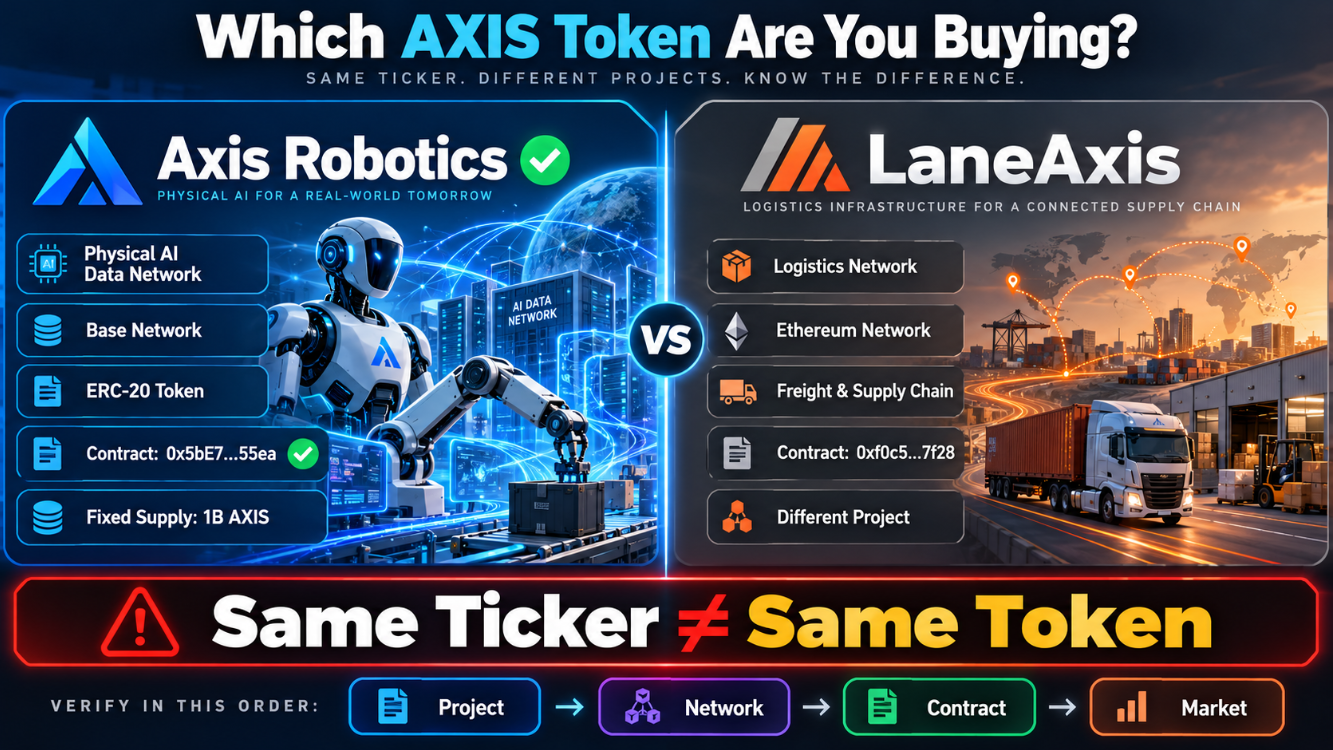
Based solely on the ticker “AXIS,” investors cannot confirm which asset they are looking at. The market contains at least Axis Robotics, LaneAxis, and other projects using similar names. If contracts, supply, and market data from different projects are mixed together, all subsequent investment conclusions will be invalid.
What Is Axis Robotics’ AXIS?
The research subject of this article is the native token of Axis Robotics. Key identity information is as follows:
- Project: Axis Robotics;
- Token: AXIS;
- Network: Base;
- Standard: ERC-20;
- Official contract:
0x5bE75e3b0aFf5D1A042A5363Ae36AcB1d6d755ea; - Fixed total supply: 1,000,000,000 AXIS;
- Official TGE circulating supply: 165,000,000 AXIS;
- Full unlock: month 35 after TGE.
This information comes from Axis Robotics official Tokenomics; HIBT and Bitget listing announcements also use the same Base contract.
What Is the Difference Between Axis Robotics and LaneAxis?
LaneAxis’s historical AXIS is a logistics and freight network token on Ethereum, with the contract:
0xf0c5831ec3da15f3696b4dad8b21c7ce2f007f28
Axis Robotics’ AXIS, by contrast, is used for a Physical AI data network, runs on Base, and its contract begins with 0x5bE75e….
The two differ in sector, network, supply structure, value source, and purchase channels. Seeing historical LaneAxis materials when searching for “AXIS Token” does not mean those materials apply to Axis Robotics, which launched in 2026.
How Can You Confirm the Correct AXIS Before Trading?
It is recommended to verify strictly in the following order:
- First confirm the project’s full name is Axis Robotics;
- Confirm the network is Base;
- Verify the full token contract character by character;
- Confirm that the AXIS contract in the trading pair matches the official contract;
- Compare total supply, price, and circulating supply to see whether they broadly match;
- Do not connect your wallet through unknown links provided in DMs, comments, or search ads.
Also distinguish between the “sale contract” and the “token contract.” The Sonar sale contract used for the official community sale handles subscriptions, allocations, and refunds; it is not the AXIS token itself. Importing the sale contract into a wallet or using it to locate trading pools can lead to asset misidentification.
2. What Is Axis Robotics Building? Why Does Physical AI Need Data Infrastructure?
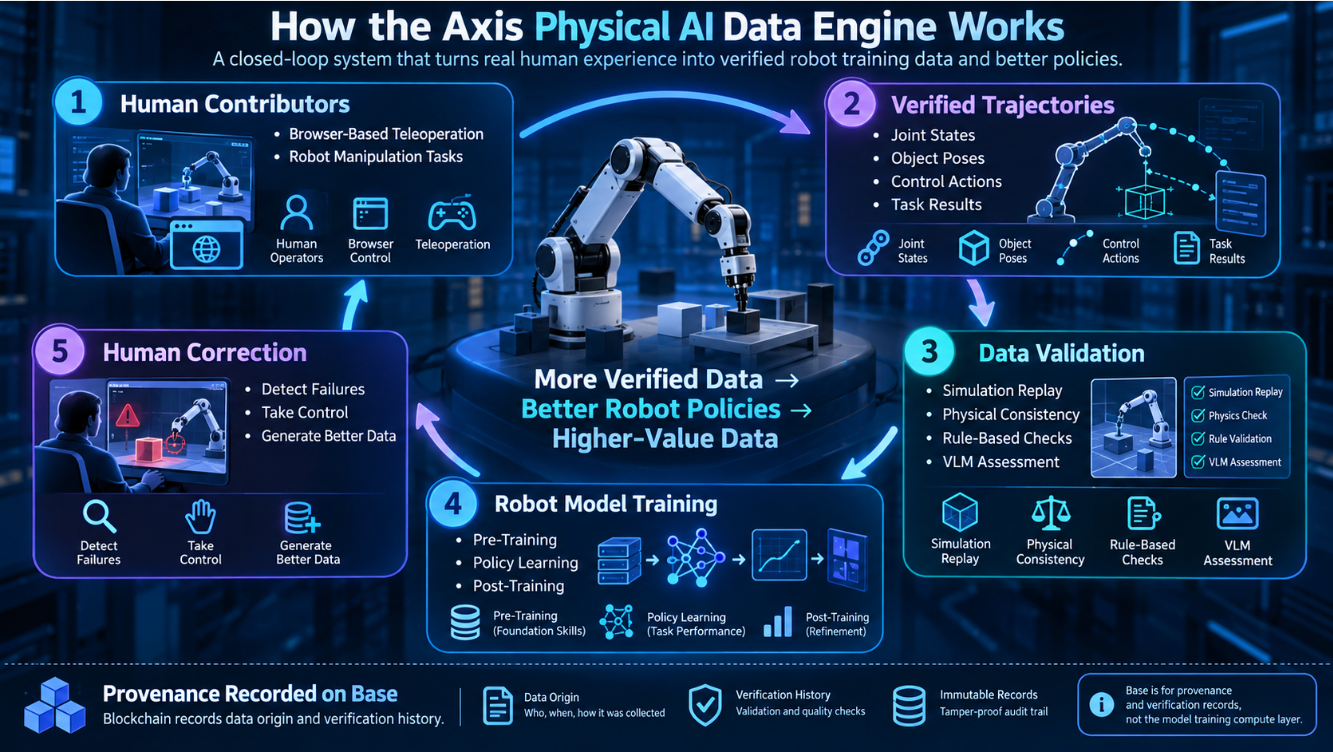
Large language models can learn from massive amounts of text and images, but robots need to understand 3D space, object states, action sequences, contact forces, and task outcomes. Teaching a robot “what a cup is” and enabling a robotic arm to reliably pick up a cup are two completely different data problems.
One of the core bottlenecks in Physical AI is that high-quality physical interaction data is difficult to acquire at scale. Real-robot data collection faces issues such as expensive hardware, limited experimental environments, insufficient operators, and narrow task coverage. Axis Robotics’ approach is to move part of robot manipulation into a browser-based simulation environment, where global contributors generate training trajectories.
What Does a Robot Training Trajectory Contain?
According to official documentation, after contributors complete simulated tasks, the system records:
- Robot joint states;
- Object positions and orientations;
- Control actions;
- Task metadata;
- Success or failure outcomes;
- Time segments of model control and human takeover during the post-training phase.
This data can be used to train robots to perform tasks such as grasping, sorting, opening drawers, and pouring objects.
How Does the Axis Robotics Data Process Work?
The platform divides tasks into three stages.
The first stage is pre-training. Contributors control the robot from scratch to complete tasks, generating complete human demonstration trajectories.
The second stage is model training. The system uses validated and processed data to train robot policies.
The third stage is post-training. The model first executes tasks on its own; when it makes errors, contributors take over and correct them, then hand control back to the model. This type of data specifically captures situations the model currently cannot handle and is theoretically more valuable than repeatedly collecting actions the model already knows.
Each trajectory also goes through structural validation, simulation replay, physics consistency checks, rule-based checks, and vision-language model evaluation. Data that cannot replay properly or does not meet task requirements will not enter the training pool.
What Problem Do On-Chain Records Solve?
Axis Robotics records part of the data provenance, task IDs, contributor IDs, and quality results on Base. The main value of on-chain records is improving provenance verifiability, making it easier to prove when a piece of data was produced, who contributed it, and whether it passed validation.
But avoid overinterpreting this:
Recording data on-chain can improve traceability, but it cannot automatically prove that the data has commercial value, nor can it prove that customers are willing to buy it.
3. Does Axis Robotics Already Have a Real Product? What Does Data Scale Prove?
Axis Robotics is not just a white-paper project. Official documentation already provides browser tasks, contributor workflows, quality scoring, and model training documentation; the project has also published a robot manipulation research paper.
The AXIS paper released in July 2026 disclosed 207 manipulation tasks, more than 50,000 human demonstrations, and more than 60,000 scene variations. The paper reports that, in its evaluation setting, continued training with AXIS data improved the π0.5 model’s overall success rate by 5.8%, and was 37.3% higher than the control pre-trained with RoboCasa365. These results indicate research-grade technical value in its data pipeline, but they should still be interpreted in light of the experimental scope, evaluation tasks, and whether the results transfer to real robots.
The platform snapshot on the official community sale page as of September 28, 2026, included:
- 5,483,803 validated trajectories;
- More than 53,106 hours of trajectory data;
- 7,700 validated tasks;
- More than 196,111 contributors.
These numbers prove high participation and data-production activity on the platform, but they do not directly prove four things:
- All contributors are consistently active users;
- Every piece of data has equal training value;
- Enterprise customers have already paid for this data;
- Product activity automatically translates into AXIS buy demand.
How Can You Tell Whether Data Scale Is Commercial Value?
Going forward, focus on finding the following evidence:
- How many enterprises or research institutions become real customers;
- Whether customers move from pilot collaborations to repeat payments;
- How much revenue per unit of data or per dataset can be generated;
- How effective data utilization differs across tasks;
- Whether models trained on Axis data can reliably improve performance in real robots;
- Whether commercial revenue grows in tandem with data scale.
The project roadmap proposes converting early POC customers into recurring revenue and pursuing commercialization goals. But a roadmap is a plan and cannot be counted as realized revenue in advance.
4. What Is the AXIS Token Used For? Axis Points and AXIS Must Be Analyzed Separately
AXIS’s investment value cannot rest only on “the project has robot data.” We must further answer: why would product usage create AXIS demand?
AXIS Use Cases Already Clarified by the Official Team
According to official Tokenomics, the clearer directions currently include:
- Contributor Rewards are used to reward validated data contributions;
- The Ecosystem allocation is used for network growth, partnerships, research, and community programs;
- Data collection programs can use budgets to incentivize contributors to complete specific tasks;
- Staking and Governance are listed as proposed features, with specific rules to be published separately before launch.
Pay attention to the wording here. “Proposed” does not mean “already available.” Before staking, governance, or advanced task permissions officially launch, they cannot all be included in the token’s current value.
Can Axis Points Be Directly Redeemed for AXIS?
No, not in that sense.
The official community sale page clearly states that Axis Points are non-transferable points, not a token; the page does not promise a fixed conversion relationship between points and AXIS. Official Tokenomics only says that Points may be used as one input for assessing eligibility and allocation sizing in specific reward programs, with specific conditions subject to separately announced program terms.
Therefore, the following inferences do not hold:
- 1 Point equals a fixed amount of AXIS;
- More points necessarily means a proportional amount of tokens;
- Participating in tasks equals risk-free airdrop yield;
- The market value of points can be calculated directly based on the AXIS price.
Why Might Product Growth Still Fail to Push AXIS Higher?
Value transmission requires a complete chain:
Enterprises need robot data → customers publish or purchase data tasks through Axis → tasks generate verifiable revenue → related economic activity requires AXIS → AXIS demand exceeds new supply
If users only contribute data to earn rewards while there are not enough customers buying data, the token may mainly serve a subsidy function. If enterprises can settle entirely in stablecoins or fiat, the necessity of AXIS may also decline. If reward releases outpace actual demand growth, product activity may instead create sell pressure.
So “the token has utility” and “the token has sustained net demand” are two different things.
5. How Is AXIS Tokenomics Structured? How Is the 1 Billion Supply Allocated?
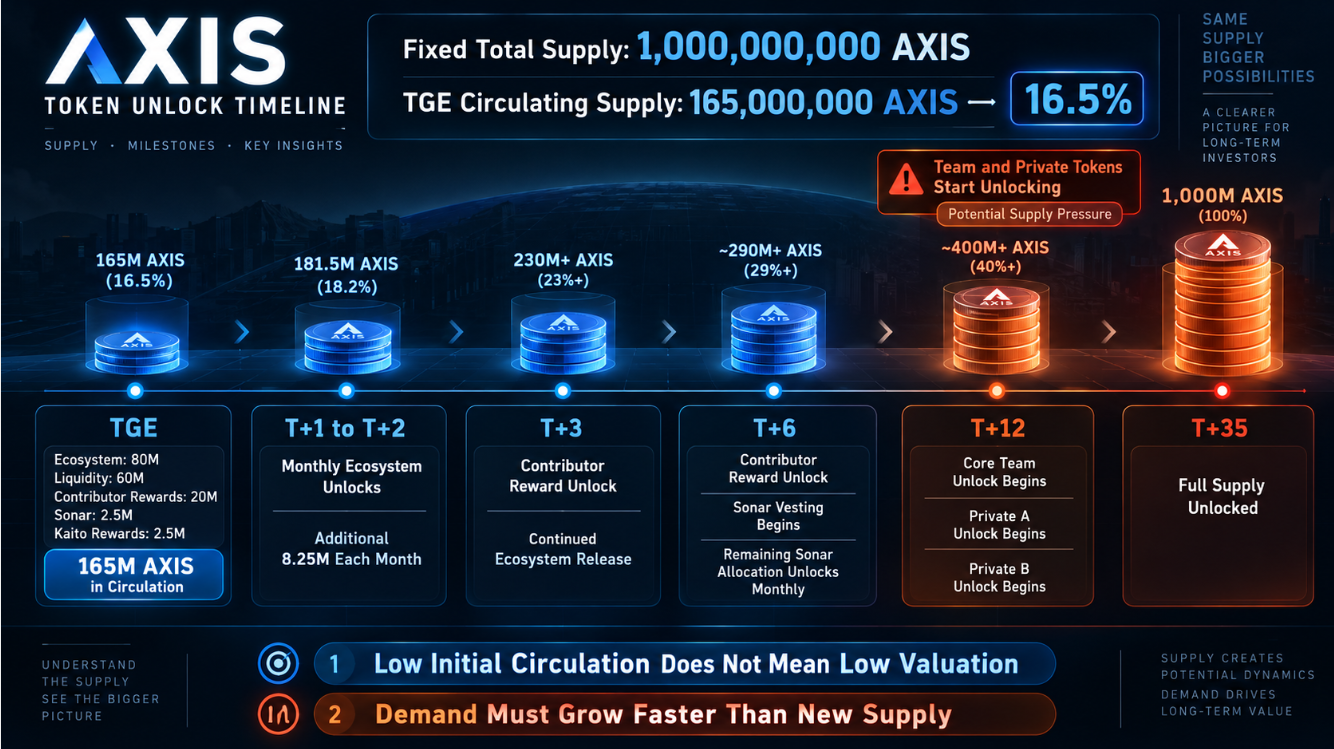
AXIS has a fixed total supply of 1 billion tokens, with no inflation and no new mint schedule. The official TGE circulating supply is 165 million tokens, or 16.5% of total supply; the remaining tokens release under different schedules, and all supply is expected to be fully unlocked by month 35 after TGE.
Allocation Structure of the 1 Billion AXIS
The official allocation includes:
- Ecosystem: 510,833,333 tokens, or 51.08%, for growth, partnerships, research, community programs, and Treasury;
- Contributor Rewards: 100,000,000 tokens, or 10%, for community contributor airdrops;
- Core team: 152,000,000 tokens, or 15.2%;
- Private A: 98,000,000 tokens, or 9.8%;
- Private B: 66,666,667 tokens, or 6.67%;
- Liquidity: 60,000,000 tokens, or 6%;
- Sonar community sale: 10,000,000 tokens, or 1%;
- Kaito reward pool: 2,500,000 tokens, or 0.25%.
Why Is the 51.08% Ecosystem Allocation Both an Opportunity and a Risk?
A large ecosystem allocation can support customer partnerships, data tasks, academic research, and user growth. If used transparently and able to generate repeat payments, the ecosystem allocation can help the project complete its cold start.
The risk is that ecosystem tokens will eventually enter the market. Investors need to continuously verify:
- Who controls the ecosystem tokens;
- How much is released each month;
- Whether it is used for incentives or direct spending;
- Whether recipients of the tokens tend to sell;
- Whether ecosystem spending brings quantifiable customers and revenue.
A large ecosystem allocation does not mean the project will succeed, nor does it mean all tokens will immediately create sell pressure. What really matters is the use of funds, release cadence, and new demand.
Which AXIS Tokens Enter Circulation at TGE?
The official initial circulating supply of 165 million tokens mainly consists of:
- Ecosystem: 80 million tokens;
- Liquidity: 60 million tokens;
- Contributor Rewards: 20 million tokens;
- Sonar sale: 2.5 million tokens;
- Kaito reward pool: 2.5 million tokens.
The core team, Private A, and Private B do not unlock at TGE; they are locked for the first 12 months and then release monthly from T+12 to T+35.
Where Will Future Unlock Pressure Be Concentrated?
Investors should pay particular attention to four phases.
The first phase is T+1 and T+2. Ecosystem allocations release monthly, and each of these two months includes an additional 8.25 million tokens.
The second phase is T+3. The official aggregate release schedule shows that Contributor Rewards release 30 million tokens at this point. In the Season 1 detailed schedule, 10 million tokens release at T+3; the remainder should be verified again against the official Season 2 terms and actual on-chain transfers.
The third phase is T+6. The official aggregate schedule shows that Contributor Rewards release 50 million tokens at this point; Season 1 releases another 10 million tokens at T+6. At the same time, the remaining 75% of the Sonar base allocation begins monthly linear vesting after a 6-month cliff. Because specific Season 2 terms may still be announced separately, investors should not infer each recipient class’s selling timeline solely from the aggregate chart.
The fourth phase is T+12. Team and two private-sale allocations begin a 24-month linear vesting period. This totals more than 316 million tokens and is an important point for medium- to long-term supply analysis.
Official Tokenomics shows that all allocations finish unlocking at T+35. Therefore, AXIS is not an asset that is “always scarce because of low float”; it is an asset with a low initial float and continuously increasing future supply.
6. Does a $0.10 Community Sale Price Mean AXIS Is Cheap?
The official community sale in September 2026 was conducted through Sonar at $0.10 per token, with 10 million tokens planned for sale, representing 1% of total supply and corresponding to a $100 million FDV.
The sale window closed on September 28, 2026. Of the base allocation received by sale participants, 25% unlocks at TGE; a separate community bonus of 5% to 25%, calculated based on the committed amount, unlocks fully at TGE; the remaining 75% vests linearly over six months after a six-month cliff.
The Community Sale Price Is Not a Market Floor
$0.10 was only the issuance price for a specific round, specific eligibility, and specific lock-up terms. It does not mean the project team guarantees a buyback, nor does it mean the secondary market will not fall below that price.
After launch, AXIS traded near 0.30 at one point, about 3x the community sale price. But you cannot simply conclude that “early investors are already up 3x” or that “0.30 is definitely overvalued,” for reasons including:
- Not all of the community sale base allocation circulates at TGE;
- The community bonus received by participants changes the blended cost;
- Different participants have different actual allocation ratios and unlock amounts;
- Secondary market prices are determined by immediate supply and demand;
- Exchange campaigns and short-term capital can significantly amplify volume in the early post-launch period.
Unit Price Is Not the Point; FDV Is What Matters
At a max supply of 1 billion tokens:
[ \text{FDV}=\text{AXIS Price}\times1,000,000,000 ]
At an AXIS price of $0.10, FDV is $100 million.
At an AXIS price of $0.30, FDV is $300 million.
Investors should not assume AXIS is cheap just because it is “under $1.” They should judge whether a robot data platform in the early commercialization stage is currently worth a fully diluted valuation of nearly $300 million.
7. Has AXIS Already Launched? Where to Buy AXIS
As of October 22, 2026, AXIS has completed its TGE and entered multiple secondary markets, so the answer to “Where to buy AXIS” has changed.
Verifiable AXIS Trading Venues
HIBT’s announcement shows that AXIS/USDT opened for trading at 11:10 UTC on October 21, 2026, on Base, and the contract listed in the announcement matches the official contract. Users can view the price, volume, and market changes via AXIS live market data.
Bitget opened AXIS/USDT spot trading at 13:00 UTC on October 21, 2026, and listed the same Base contract in its announcement.
Upbit has opened AXIS/KRW, AXIS/BTC, and AXIS/USDT markets. CoinGecko’s October 22, 2026 snapshot showed that Upbit’s AXIS/KRW was the highest-volume market at the time.
AXIS/USDC pools also exist on Uniswap V4 and Uniswap V3 on Base. In the CoinGecko snapshot, Uniswap V4 had higher volume and better depth within ±2% than V3.
In addition, HTX, MEXC, and other platforms have also published AXIS trading arrangements. Available platforms vary by region, and before trading you should confirm account eligibility, local regulations, deposit network, and withdrawal status.
What Should You Check Before Buying AXIS on HIBT?
- After logging in, search for AXIS/USDT; do not enter only through an external link;
- Confirm the project name is Axis Robotics;
- Confirm that the deposit and withdrawal network is Base;
- Verify the full contract in the platform announcement;
- Check the latest price, 24-hour volume, bid-ask spread, and order book depth;
- Use a small order for your first trade to verify execution;
- Before withdrawing, confirm again that the destination wallet supports Base.
What Else Should You Check When Buying on a DEX?
When trading on a DEX such as Uniswap, you must manually confirm the token contract. Also check the pool’s quote asset, fee tier, liquidity, price impact, and maximum slippage.
Do not assume a pool is the official asset just because it displays the AXIS name and logo. Names can be faked; the contract address is the only identifier.
8. What Does AXIS’s Post-Launch Market Performance Tell Us?
CoinGecko’s October 22, 2026 snapshot showed:
- AXIS price was around $0.29 to $0.30;
- 24-hour volume was about $148 million;
- Circulating market cap was about $48.5 million;
- FDV was about $294 million;
- CoinGecko showed about 170 million tokens in circulation;
- Official Tokenomics and CoinMarketCap show a TGE circulating supply of 165 million.
There is already a notable data discrepancy here: CoinGecko’s circulating supply is about 170 million tokens, while the official initial circulating supply is 165 million. The difference may come from update timing, rewards, or platform methodology, but it cannot be ignored in formal valuation. A more robust approach is to rely on the official unlock schedule and on-chain holdings as the basis, while using market data platforms as market references.
Does High Volume Prove Long-Term Capital Conviction?
No.
First-day volume may include:
- New-token price discovery;
- Exchange campaigns and Launchpool capital;
- Korean market short-term trading;
- DEX arbitrage;
- Perp-spot hedging;
- Community sale and airdrop recipients cashing out.
Volume only proves trading activity; it does not prove that this capital is willing to hold AXIS long term.
How Large Are the Differences in Trading Quality Across Markets?
At the time, CoinGecko showed that Upbit’s AXIS/KRW depth within ±2% was about $55,000 and $84,000; Uniswap V4’s depth within ±2% was close to $49,000; Bitget’s depth within ±2% was clearly lower.
These numbers change quickly, but they show that the large-order execution experience for the same AXIS varies completely across markets. Before buying, compare not only price but also spread, depth, and withdrawal conditions.
9. Is AXIS Worth Buying? It Must Pass Three Validation Gates
I would not judge AXIS as worth a long-term buy solely because the Physical AI industry is growing. It must pass at least three gates simultaneously.
Gate 1: Product Adoption Must Translate into Commercial Demand
We need to see real customers, repeat purchases, paid data tasks, or recurring revenue—not just growth in contributors and trajectory counts.
The truly valuable questions include:
- Why would enterprises choose Axis instead of building in-house or using another data platform?
- Does Axis data consistently improve real-robot performance?
- Are customers willing to buy repeatedly?
- Is commercial revenue growing?
Gate 2: Commercial Demand Must Translate into AXIS Demand
Even if the platform has customers, we need to verify why customers or developers must use AXIS. If AXIS is mainly used to subsidize contributors while customer payments do not require buying the token, value capture may be weak.
Watch for:
- How many tasks actually use AXIS budgets;
- Whether AXIS payments, staking, or task permissions are live;
- Whether token demand comes from the product rather than trading activity;
- Whether reward recipients sell immediately.
Gate 3: New Demand Must Exceed New Supply
Initial TGE circulation was only 16.5%, and future supply will continue to increase. Even if project users grow, price may still come under pressure if unlocks are faster.
Analyze monthly unlocks, ecosystem spending, contributor rewards, and trading depth together.
All three gates are required:
A product being used does not mean the token is needed; a token being used does not mean new demand is sufficient to support the current valuation.
10. What Is the Biggest Bull Case for AXIS?
The real bullish scenario for AXIS is not that “the robot narrative stays hot,” but that Axis Robotics becomes an important supply network for robot training data and forms a closed loop among customers, data, and the token.
A convincing bull case needs to see:
- Effective data and task types continue to increase;
- Model experiments are reproduced across more tasks and real robots;
- POC customers convert into repeat-paying customers;
- Data purchases and task budgets generate verifiable revenue;
- AXIS becomes an important component of task settlement, contributor rewards, or access to high-value tasks;
- Spot liquidity expands, and future unlocks do not clearly overwhelm the market;
- The current valuation does not grow faster than revenue and product adoption over the long term.
If these conditions are gradually met, AXIS can shift from an “AI narrative new token” to a “data network token with business validation.”
11. What Is the Biggest Bear Case for AXIS?
The bear case is not just a price decline; it is the failure to establish connections among the product, token, and market.
Watch for:
- Trajectory counts keep growing, but there are not enough paying customers;
- Contributors produce large amounts of low-marginal-value data for rewards;
- The token is mainly used for subsidies and lacks external buy demand;
- Staking and governance features remain “Proposed” for a long time;
- Ecosystem releases and contributor rewards create persistent sell pressure;
- Demand is insufficient when team and private-sale tokens unlock after T+12;
- Spot depth drops significantly after launch hype fades;
- Physical AI value is mainly captured by model, hardware, or robot manufacturers rather than the Axis network.
If several of these conditions appear at the same time, long-term valuation should be reduced rather than using “AI is the future” to avoid project-level execution issues.
12. How Should You View AXIS Price Predictions?
Investors can refer to AXIS price prediction to understand market expectations, but prediction pages cannot replace fundamental valuation.
Bull Scenario
Product adoption continues to grow, enterprise customers begin repeat payments, AXIS task budgets and actual usage increase, spot liquidity improves, and monthly new demand can absorb unlock supply.
In this case, the market may be willing to assign AXIS a higher infrastructure valuation.
Base Scenario
Contributors, trajectories, and research progress continue to grow, but commercialization and token demand remain unclear. After trading hype fades, price trades more around market sentiment and unlock expectations.
In this case, a more reasonable strategy is to keep observing rather than treating product vision as revenue in advance.
Bear Scenario
Commercial customer growth is below expectations, progress on actual AXIS use is slow, ecosystem rewards and future unlocks increase supply, and broader market risk appetite declines.
In this case, FDV may compress quickly, and the community sale price cannot provide reliable support.
Do Not Just Ask Whether AXIS Can Reach $1
If the AXIS price reaches $1, FDV would be $1 billion at a max supply of 1 billion tokens.
A more valuable question is:
What customer scale, revenue, token demand, and market share would Axis Robotics need to support a $1 billion fully diluted valuation?
If you cannot answer that question, $1 is just a target number without a basis.
13. How Is AXIS Different from DNA and KIMCHI?
AXIS and DNA both carry AI labels, but their product directions differ. AXIS focuses on robot training data and Physical AI; DNA focuses more on AI agents and economic decision networks.
When researching DNA, you can observe the market via DNA live market data and refer to DNA price prediction to understand market expectations. But both must answer the same value-capture question: why does product use increase token demand?
AXIS requires looking at enterprise data demand, trajectory quality, task budgets, and unlocks; DNA requires looking at agent usage, service payments, product adoption, and unlocks. You cannot compare only price gains just because both are AI projects.
KIMCHI Crypto follows a different logic. KIMCHI relies more on meme propagation, community attention, holder structure, and pool depth; AXIS has a product, research, and tokenomics, so it must face stricter scrutiny of commercialization and value capture.
In short:
- KIMCHI mainly trades attention;
- DNA mainly validates AI agent adoption;
- AXIS mainly validates robot data commercialization.
Different asset types require different valuation methods.
14. How Will BTC and ETH Trends Affect AXIS?
BTC price prediction can help judge whether the overall crypto market is in a risk-on expansion or risk-off contraction phase. When BTC falls quickly, newly launched, low-float, high-FDV projects usually face more obvious capital outflow and valuation compression.
ETH price prediction has additional meaning for AXIS because AXIS runs on Base, which is part of the Ethereum Layer 2 ecosystem. Improving ETH and on-chain application risk appetite may increase market attention to Base ecosystem assets.
But it must be clear:
BTC and ETH are market environment variables, not AXIS fundamental variables.
Even if BTC and ETH rise, AXIS may still underperform if Axis Robotics has no customers, token demand is insufficient, or unlock pressure increases.
15. If You Decide to Participate in AXIS, What Investment Strategy Should You Use?
Strategy 1: Confirm the Asset Before Considering Price
Trade only the Axis Robotics token corresponding to the Base contract 0x5bE75e3b0aFf5D1A042A5363Ae36AcB1d6d755ea. Do not rely solely on the ticker, logo, or search ranking.
Strategy 2: Do Not Chase First-Day Volume
Early post-launch volume is affected by campaigns, arbitrage, airdrop selling, and price discovery. It is better to wait for prices across markets to stabilize before judging whether spot demand persists.
Strategy 3: Look at Both Circulating Market Cap and FDV
The current float is about 16.5%, meaning circulating market cap reflects the valuation of only a small amount of released tokens. Investors must also calculate fully diluted valuation and monitor supply changes over the next 35 months.
Strategy 4: Reassess Around Unlock Events
Focus on supply changes around T+1, T+2, T+3, T+6, and T+12. Do not look only at the so-called “next major unlock,” because monthly ecosystem releases can also create persistent pressure.
Strategy 5: Scale In Gradually; Do Not Go All-In at Once
You can start with a small observation position and decide whether to add after product adoption, token usage, and liquidity are further validated. Scaling in does not eliminate risk, but it can reduce the risk of making a one-shot bet during the least efficient price-discovery phase.
Strategy 6: Define Invalidation Conditions in Advance
Reassess if the following occur:
- Enterprise adoption shows no progress for a long time;
- Actual token utility does not expand;
- Data scale grows but commercial revenue is missing;
- Unlocks increase while spot depth declines;
- Price gains rely mainly on exchange campaigns and short-term derivatives;
- The project roadmap is repeatedly delayed.
16. 10 Risks You Must Know Before Investing in AXIS
- Same-name token risk: Axis Robotics and LaneAxis both use the AXIS ticker.
- Product commercialization risk: Data scale does not necessarily translate into paying customers.
- Value capture risk: Product success does not necessarily increase AXIS demand.
- Low initial float risk: A 16.5% TGE float can amplify price volatility and FDV misjudgment.
- Token unlock risk: Ecosystem, contributor, team, and private-sale tokens enter circulation at different stages.
- Early post-launch price discovery risk: Market prices can be significantly affected by campaigns, arbitrage, and short-term capital.
- Liquidity discrepancy risk: Depth, spreads, and exit experience differ across exchanges and DEXs.
- Points misinterpretation risk: Axis Points are not AXIS and have no fixed conversion promise.
- Technology and data quality risk: Scale of simulated data does not equal generalization ability in real robots.
- Regulatory and platform risk: Sales and trading are subject to regional eligibility, KYC, network, and platform rules.
17. FAQ: Common Questions About the AXIS Token
What is the AXIS token?
AXIS is an ERC-20 token issued by Axis Robotics on Base. The project collects robot training data through browser-based simulated tasks and human corrections, then validates, processes, and traces the data on-chain.
What does Axis Robotics do?
It is a robot data infrastructure platform for Physical AI, aiming to lower the cost of collecting high-quality manipulation trajectories and correction data.
Where to buy AXIS?
As of October 22, 2026, AXIS can be traded on HIBT, Bitget, Upbit, HTX, MEXC, and Uniswap on Base. Availability differs by region and platform; before trading, you must verify the official contract, network, and market depth.
Which chain is AXIS on?
Axis Robotics’ AXIS is issued on Base.
What is the official AXIS contract?
0x5bE75e3b0aFf5D1A042A5363Ae36AcB1d6d755ea
Can Axis Points be redeemed for AXIS?
The official team has not promised a fixed conversion relationship. Points are non-transferable points and may be used as an evaluation input for specific reward programs, but they cannot be directly converted into AXIS at a fixed ratio.
What is the total supply of AXIS?
The fixed total supply is 1 billion tokens, with no additional inflation or new mint schedule.
What is the TGE circulating supply of AXIS?
Official Tokenomics gives an initial circulating supply of 165 million tokens, or 16.5% of total supply. Market data platforms may differ in methodology; cross-verify with official unlocks and on-chain data.
What was the AXIS community sale price?
The official Sonar community sale price was $0.10, selling 10 million tokens, or 1% of total supply. That price applied to specific lock-up terms and is not a secondary-market floor.
When does AXIS unlock?
Schedules differ by category. Ecosystem and contributor rewards release in early stages; the remaining 75% of the Sonar base allocation vests linearly over six months after a six-month cliff; team and private-sale tokens are locked for 12 months and then vest linearly over 24 months; all supply is expected to be fully unlocked by T+35.
Is AXIS worth buying?
Axis Robotics is worth researching, but AXIS is still a high-risk early-stage asset. The long-term investment thesis becomes more complete only when product adoption, token demand, and supply absorption capacity are all validated.
How should I view AXIS price predictions?
Analyze customer adoption, token utility, circulating market cap, FDV, unlocks, and liquidity together; do not judge based only on the AI narrative or a single candlestick target.
What is the difference between AXIS and LaneAxis?
Axis Robotics is a Physical AI data project on Base; LaneAxis is a logistics network project on Ethereum. They use different contracts, and their materials cannot be mixed.
What is the biggest investment risk for AXIS?
The biggest structural risk is that product activity fails to create real demand for AXIS while future unlocks continuously increase market supply.
18. Final Verdict: Is AXIS Worth Buying?
My judgment is: Axis Robotics’ Physical AI data infrastructure is worth continued research, but AXIS is still an early-stage, high-risk asset whose value capture has not yet been sufficiently validated.
The project already has a functioning task system, a sizable contributor network, public research, and a verifiable data pipeline. This distinguishes it from concept tokens that rely only on an AI label.
But investing in AXIS is not just about judging whether the robotics industry will grow. Investors must continue to answer three questions:
- Can Axis Robotics convert data activity into stable customers and revenue?
- Can customer demand translate into actual AXIS buying, settlement, or lock-up demand?
- Can new demand absorb the token supply continuously released over the next 35 months?
As of October 22, 2026, AXIS is already tradable, and the $0.10 community sale price no longer represents the current market price. The post-launch price near $0.30 means the market has already priced in a significant portion of Physical AI growth expectations.
Therefore, I will not chase the hype based solely on “AI + Robotics + Base,” nor will I assume the token is cheap just because its unit price is below $1. I will continue to monitor enterprise customers, paid tasks, actual AXIS usage, monthly unlocks, and spot depth.
Only if product adoption grows, token demand strengthens, and unlock supply is absorbed will there be a reason to raise AXIS’s long-term investment rating. If data scale grows without commercial revenue and token utility remains at the planning stage for a long time, then no matter how hot the Physical AI sector is, it will not be enough to support a long-term bullish view.
First confirm the asset’s identity, then validate product demand, then analyze token value capture, and only then evaluate price. The order cannot be reversed.
References and Data Sources
- Axis Robotics official documentation: What Is Axis Robotics
- Axis Robotics official Tokenomics
- Axis Robotics community sale page
- AXIS research paper
- HIBT announcement on listing AXIS
- Bitget announcement on listing AXIS
- CoinGecko: Axis Robotics market data
- CoinMarketCap: Axis Robotics
Market data updated: October 22, 2026. Dynamic data should be refreshed again before formal publication.