
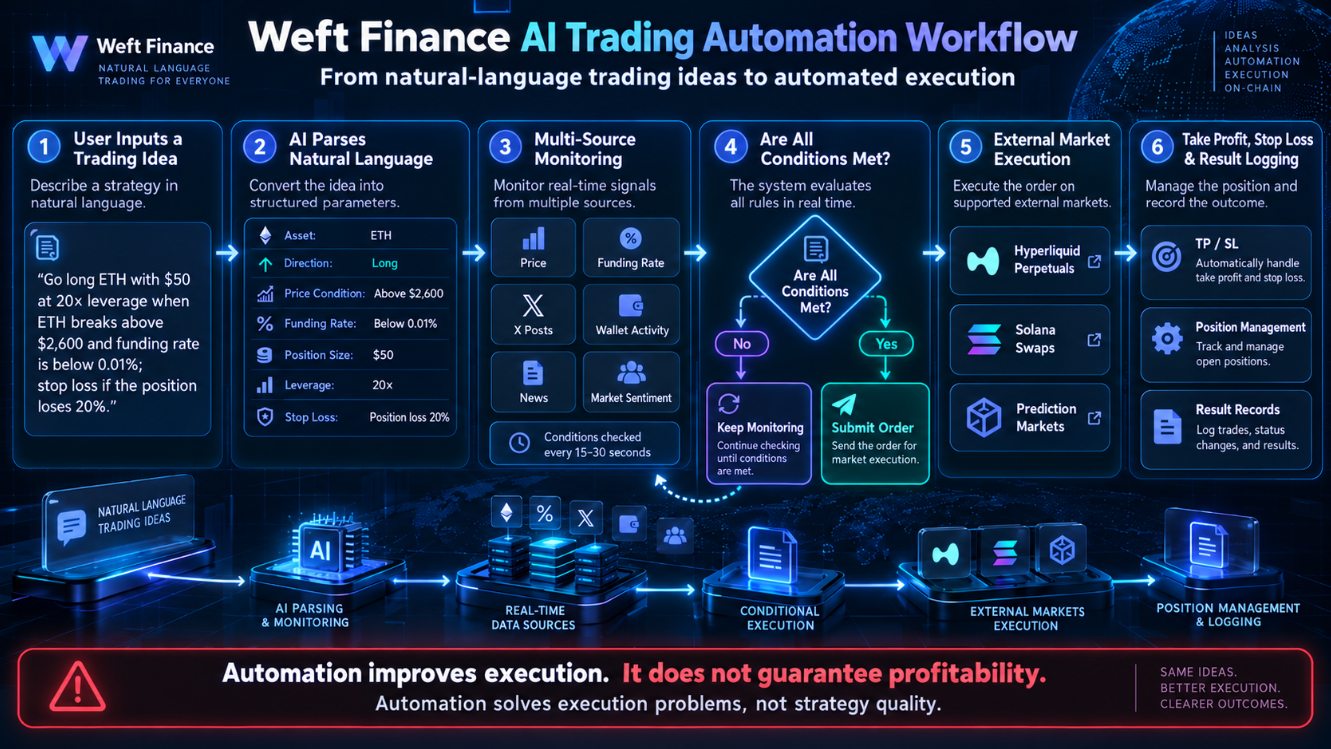
Weft Finance is an automated execution platform for traders. Users can describe a trading idea in natural language, and the system breaks the sentence into checkable conditions, continuously monitors signals such as prices, funding rates, social media, and on-chain wallets, and executes orders when the conditions are met.
But this does not mean Weft can predict the market, and it certainly does not mean using it will produce consistent profits. Its first job is to turn ideas into rules and execute them automatically. Whether a strategy has an edge still depends on signal quality, trading costs, execution speed, and risk control.
My view on the WEFT token is also clear: Weft’s product direction is worth studying, but WEFT is still a high-risk, small-cap asset that needs to prove product adoption, fee revenue, and token value capture. “AI trading” can generate attention, but it cannot replace real users, real revenue, real buybacks, or sufficient exit liquidity.
This article examines the WEFT deployed on Solana with the official website weft.fi, not the same-name lending protocol on Radix. Market data is as of October 23, 2026. Prices, liquidity, holders, and volume will change, and should be re-verified before trading.7 Things to Know Before Investing in WEFT
- Weft’s core capability is natural-language strategy orchestration and automated execution, not AI prediction that guarantees profits.
- Weft says the system checks conditions every 15–30 seconds. That suits conditional trading, but it is not the same as millisecond-level high-frequency execution.
- Weft says part of its fees will be used to buy back WEFT and distribute tokens among traders, strategy creators, and burns. Investors should still verify actual revenue and on-chain buyback records.
- The official Solana contract for WEFT is
HqmFi85adLD8BQA7en1HfajdAfzVFps5REgQaYuw6Ax8. - On-chain data platforms show that mint and freeze authorities have been disabled. That is a positive signal, but it does not eliminate product, liquidity, or whale-selling risks.
- As of this article’s data snapshot, WEFT had been live for less than a month, and liquidity was significantly smaller than daily volume. It remains in a highly volatile price-discovery phase.
- A useful product does not mean the token must appreciate. WEFT must prove that product usage can sustainably generate fees and that fee-funded buybacks are enough to create measurable token demand.
1. What Exactly Is Weft Finance? First, Distinguish the New Solana Project from the Radix Lending Protocol
What does Weft Finance do?
Weft’s product slogan is “Trade the thesis”—turning a trading view into rules that can run automatically. Users do not have to write code from scratch. They can directly enter conditions such as:
- When ETH is above a certain price;
- And the funding rate is below a set threshold;
- Open a long with a specified amount and leverage;
- Stop out when the position loss reaches a certain percentage.
The system breaks the sentence into the trading asset, trigger conditions, direction, amount, leverage, and exit rules, displays them in a readable form first, and then continuously monitors the market. According to Weft’s official product page, conditions are checked every 15–30 seconds, and an order is submitted only when all conditions are met.
So rather than calling Weft an “AI bot that predicts price moves,” it is better understood as: a natural-language strategy editor + a data monitor + an automated execution engine.
WEFT on Solana and WEFT on Radix are not the same project
When searching for Weft Finance, users will encounter two projects with very similar names but fundamentally different substance.
The newer Weft discussed in this article uses the weft.fi domain, focuses on automated trading, and has its token deployed on Solana. Its value proposition centers on strategy execution, fee buybacks, user rewards, and token burns.
The other project, weft.finance, is a lending protocol on Radix DLT with features including deposits, collateralized lending, staking, and governance. Radix officially describes it as a decentralized lending platform, and its WEFT token belongs to a different network and economic model. The contracts, supply, product data, and valuation logic of the two cannot be mixed. For background on the older project, see Radix’s introduction to Weft Finance.
How to confirm that this article is about the right WEFT
The only contract address listed on the official Solana version’s page is:
HqmFi85adLD8BQA7en1HfajdAfzVFps5REgQaYuw6Ax8
Before trading, complete at least four checks:
- The network must be Solana.
- The full contract address must match exactly, character by character. Do not rely only on the WEFT ticker.
- The official website, social accounts, block explorer, and trading pool should all point to the same address.
- The supply and price shown on the market data page should broadly correspond to the target trading pool.
If the contract cannot be confirmed, there is no point discussing a target price. Analyzing the wrong asset invalidates every conclusion that follows.
2. How Does the Weft Trading Bot Work? Natural Language, Condition Monitoring, and Automated Execution

Step 1: Turn one sentence into executable rules
The convenience of natural language is that it lowers the programming barrier, but vague expressions can also introduce errors. A complete strategy should at least specify:
- Which asset to buy or sell;
- What the trigger conditions are;
- Whether multiple conditions must be met “all at once” or “any one of them”;
- How much capital to use;
- Whether to use leverage;
- When to take profit, stop out, or stop the strategy.
Users should not just look at the polished summary generated by the system. They should check the parsed result line by line. For example, whether “stop out after a 10% drop” refers to the asset price, margin, or position P&L can lead to completely different risks.
Step 2: Continuously monitor external signals
Conditions listed on the official page include prices, funding rates, X posts and discussion heat, specified wallets, Hyperliquid traders, prediction markets, news, the Fear & Greed Index, macro interest rates, weather, and sports results.
The richer the data sources, the greater the strategy combination space—but the more failure points there are. Investors need to consider:
- Whether the data is timely;
- Whether social content may be misclassified;
- Whether an on-chain address really belongs to the intended person;
- Whether news sources are duplicated or delayed;
- How the strategy handles external API failures.
The official 15–30 second polling interval also means Weft is better suited to minute-level or longer conditional automation, not to low-latency high-frequency trading.
Step 3: Submit orders when conditions are met
Trading scenarios listed by Weft include Hyperliquid perpetuals, Solana token swaps, prediction markets, liquidity pools, and equities. Options are marked as coming soon. In actual use, users should still confirm in the app whether a feature is fully live, limited-access, or merely shown as a roadmap item.
The most important distinction is this: correct execution of rules only proves that automation completed its task; it does not prove that the strategy itself is effective. If the signal has no predictive power, more reliable execution may simply produce more reliable losses.
3. Does Automated Trading Really Lower the Barrier? Convenience and Strategy Risk Must Be Separated
Weft may indeed make it easier for non-coders to build conditional trades, but what it lowers is the barrier to “writing a program,” not the barrier to “understanding the market.”
Evaluating an automated strategy should be divided into three layers:
- Rule correctness: Did the system accurately understand and preserve the user’s settings?
- Execution quality: After a trigger, are orders placed promptly, and are fills, slippage, and fees reasonable?
- Strategy effectiveness: After enough samples and after deducting all costs, does the strategy still produce positive risk-adjusted returns?
A “buy the breakout” rule may be executed accurately, yet still run into a string of false breakouts in a range-bound market. A strategy that follows smart wallets may also enter only after the target address has already bought and pushed up the price, because of recognition delays.
When validating a strategy, focus on net returns, maximum drawdown, consecutive losses, sample size, and performance across different market environments. Showing only successful cases without failed samples creates obvious survivorship bias.
4. Are Weft Accounts and Funds Safe? No Withdrawal Permission Does Not Mean No Risk
According to Weft’s official security explanation, the platform receives trading permissions: it can place orders, cancel orders, set take-profit and stop-loss orders, and perform swaps within the user’s own wallet. It cannot directly withdraw funds or send them to other addresses. Funds remain in the user’s Hyperliquid account or Solana wallet.
This permission isolation can reduce the risk of assets being directly transferred away, but it does not eliminate the following issues:
- A wrong strategy may keep trading and cause losses;
- Leveraged positions may be forcibly liquidated;
- Leaked trading keys may lead to unauthorized buys and sells;
- Platform or external venue failures may prevent stop-losses from executing as expected;
- Users may enter the wrong amount, leverage, or trigger condition, and the system may faithfully execute the wrong instruction;
- Actual fills for low-liquidity assets may deviate significantly from expectations.
Weft offers $10,000 in simulated funds and an alert-only, no-live-trading mode. A more reasonable sequence is: first use alert mode to check signals, then use simulated funds to validate rules, and only then test fills, fees, and exit processes with a very small amount of real capital.
5. What Is the WEFT Token Used For? How Do Buybacks, Rewards, and Burns Work?
The officially disclosed value-capture path
Weft says that a portion of platform fees and certain fees from WEFT trading will be used to buy back tokens on the open market in small amounts, roughly every ten minutes. The repurchased tokens are handled as follows:
- 50% distributed to traders who use the product;
- 20% distributed to strategy creators whose strategies are used by others;
- 30% burned immediately.
Weft also says Hyperliquid perpetual trading charges a 0.10% fee, spot selling charges 1%, Solana swaps charge 1%, and WEFT’s own trading fee is 3%, of which 0.4% is used for buybacks, 0.6% goes to Meteora, and the rest goes to Weft. Holding at least 100,000 WEFT provides a 25% fee discount and a 1.5x reward multiplier; holding 1,000,000 WEFT corresponds to higher discounts and reward multipliers. Specific parameters may change and should be based on Weft’s official page and the Rewards page.
Why doesn’t a buyback mechanism mean the price must rise?
Buybacks only have economic meaning when the product generates real fees. The full chain should be:
Real users run strategies → fees are generated → part of the fees buy back WEFT → rewards or burns → token demand and supply changes.
If any link in the chain breaks, value capture may weaken:
- Many users register, but most only use free or simulated features;
- There is trading volume, but fee revenue is very low;
- There are buybacks, but their scale is far smaller than market sell pressure;
- Rewards are immediately sold after being distributed to users;
- Buyback records or revenue statistics cannot be independently verified.
Therefore, “a buyback rule exists” and “buybacks are enough to support valuation” are two different things. Investors should check the Revenue page, on-chain buy orders, burn addresses, and actual buyback amounts, rather than simply repeating the economic model.
Holding WEFT is not the same as holding company equity
Fee discounts, reward boosts, and buyback-and-burn do not mean holders own equity in Weft, nor do they automatically constitute a fixed dividend right or principal-protected return. WEFT’s price is still determined by market supply and demand, and token holders bear the risk of a highly volatile crypto asset.
6. What About WEFT’s Supply, Authorities, and Holder Structure?
As of October 23, 2026, multiple public pages showed that the Solana version of WEFT had a total supply and circulating supply of about 948 million tokens, with the circulating ratio close to the full supply. The Metaplex page showed that both mint and freeze authorities had been disabled. This means that under the current authority setup, new tokens cannot be arbitrarily minted and user tokens cannot be frozen—a more positive structure than keeping those authorities active.
But “no minting authority” does not mean “no selling pressure.” Existing large holders can still sell.
Metaplex and Phantom gave top-10 holder concentrations of about 30.82% and 36.15%, respectively. The difference may come from snapshot timing, whether liquidity pools are included, burn addresses, or other program accounts. The right approach is not to choose the more flattering number, but to identify the nature of each top address one by one.
When studying holder structure, further questions should be answered:
- Is the largest address a trading pool or program account?
- Could multiple large addresses be controlled by the same entity?
- Are early wallets continuously transferring tokens into the trading pool?
- Is a decline in top holdings healthy diversification, or concentrated distribution by large holders?
- Can buyback, reward, and burn addresses be clearly identified?
7. How Hot Is WEFT Trading Right Now? Volume Is Not the Same as Exit Capacity
Based on market snapshots from Phantom, Metaplex, and Jupiter around October 23, 2026, WEFT traded at about 0.00038–0.00040, with a market cap of about 360,000–380,000, about 2,200 holders, and 24-hour volume of about $228,000. Phantom showed liquidity of about $67,000 at the time; Metaplex and Jupiter pages showed figures ranging from about $37,000 to $73,000. The differences show that data sources, snapshot times, and counted pools may differ. Before placing an order, users should directly check the target trading pool.
Using the data at the time for a rough calculation, 24-hour volume was about 3–6x liquidity. That indicates active turnover, but it does not prove that the market can absorb large exits without slippage.
An OpenSea historical snapshot also shows that WEFT hit an interim high of about $0.003436 on October 19, 2026, and at one point posted a weekly gain of more than 700%. Compared with the subsequent price of about $0.00038, this reflects the extremely high price-discovery volatility of a new token in its early stage.
Truly useful market checks include:
- Simulating slippage when selling $100, $1,000, and larger amounts;
- Checking the bid-ask spread and asset balances on both sides of the pool;
- Comparing unique buyers and sellers, not just transaction counts;
- Observing whether liquidity increases along with price;
- Checking whether large addresses are continuously selling.
Market cap is price multiplied by supply; it does not mean an equivalent amount of capital can exit. Volume is cumulative trading over a period; it is not the same as current depth in the pool.
8. Has Weft Proven Product Adoption? What Data Do Investors Still Need?
The official website shows the product mechanics, strategy examples, and a Revenue entry point. But for WEFT to move from “a new token with a product” to “an asset with verifiable value capture,” more rigorous data must be disclosed consistently:
- Daily and monthly active trading users;
- The number of live strategies, not AI drafts;
- Strategy execution count and total trading volume;
- Fee revenue by market;
- Buyback amounts, average buyback prices, and burn quantities;
- User retention and repeat usage rates;
- Strategy net performance after slippage, funding rates, and platform fees;
- System failures, failed orders, and abnormal execution rates.
If user growth remains limited to registrations, simulations, or short-term airdrop behavior, product heat may not translate into sustainable revenue. If fee growth does not lead to verifiable buybacks, it also does not prove that value has been passed to WEFT.
9. Is WEFT Worth Buying? Validate the Product First, Then Judge Valuation
My current judgment is: WEFT can go on a high-risk watchlist, but it is not suitable for heavy positions or chasing highs based solely on the “AI trading bot” narrative.
Improving the assessment requires at least five conditions to improve at the same time:
- Real active users and live strategies continue to grow.
- Fee revenue can be verified on a regular basis, not just trading volume or social hype.
- Buybacks, rewards, and burns continue on-chain and can be matched with revenue data.
- Holder concentration falls, or the nature of large addresses is reasonably explained.
- Liquidity and trading depth can grow with market cap, rather than price rising while depth falls.
The following would make me lower my assessment or walk away:
- Product activity does not improve, but the token price is mainly driven by concept hype;
- Buyback scale cannot be reconciled with official revenue;
- Trading volume is high, but selling slippage keeps worsening;
- Top wallets keep transferring tokens into the trading pool;
- The automated product suffers serious mis-execution or a security incident;
- Official feature descriptions remain inconsistent with what is actually available for a long time.
A useful product does not mean the token has value. Users may like Weft without needing to hold a large amount of WEFT long term; the economic value generated by the product may also accrue more to the operator, external trading venues, or users themselves. Only a clear demand transmission mechanism and verifiable data can support a higher valuation.
10. WEFT Price Prediction: Use Three Scenarios Instead of False Precise Targets
WEFT has been listed for only a short time and has limited liquidity, with insufficient long-term historical samples. Giving precise target prices for 2027 or 2030 at this point may look specific, but the credibility is actually very low.
Bull Case: Product and Token Demand Grow Together
The optimistic scenario requires live users, strategy execution volume, and fee revenue to keep rising; buybacks and burns to be verifiable on-chain; and liquidity to improve significantly. Only then might the market reprice WEFT from a short-term new token into an application-type asset supported by product revenue.
Base Case: The Product Has Users, but Value Capture Remains Unclear
The neutral scenario is that the product gains a group of users but does not sufficiently prove fee scale, user retention, and token demand. WEFT may continue to trade with high volatility around product updates and market sentiment, and short-term price gains should not automatically be extrapolated into long-term value.
Bear Case: Product Adoption Falls Short and Market Heat Fades
The pessimistic scenario includes stagnant user growth, very small buybacks, concentrated holdings, declining liquidity, or failures in automated execution. In that case, WEFT may be revalued as a low-liquidity new token, with pressure on both price and exit conditions.
What would truly overturn the bullish case is not how much the price falls on any given day, but this: user growth does not produce revenue, revenue does not produce buybacks, buybacks do not improve supply and demand, and liquidity is still deteriorating.
11. What Is the Difference Between WEFT, AXIS, and KIMCHI?
The market may lump WEFT and AXIS into the AI narrative, but their sources of value are different. WEFT is closer to a trading strategy automation tool, with core metrics being active users, execution count, fees, buybacks, and burns. If AXIS positions itself as Physical AI data infrastructure, research should focus on data supply, customer adoption, and infrastructure value capture. Readers can use AXIS live price and AXIS price prediction to observe market expectations, but one asset’s valuation model should not be directly applied to another.
The difference between WEFT and KIMCHI is even clearer. WEFT at least proposes a product and a fee-buyback path, and should be subject to scrutiny of product adoption, revenue, and value capture. Meme assets like KIMCHI rely more on community attention, holder structure, and liquidity. For the latter framework, see What Is KIMCHI Crypto.
This does not mean “WEFT with a product is necessarily better than a meme coin.” If the product has no users and revenue cannot be verified, the product narrative may also be just another market story.
12. How Will BTC and ETH Trends Affect WEFT?
WEFT’s fundamentals come from product usage and token mechanics, but it is still a small-cap crypto asset and cannot escape overall risk appetite.
When BTC suffers a major drawdown, capital usually cuts positions in less liquid and more volatile assets first. WEFT may then face fewer buyers, wider spreads, and higher slippage. BTC price prediction can help assess the broader market environment.
ETH’s performance can reflect whether the market is willing to pay higher valuations for on-chain applications and infrastructure. ETH price prediction can also be used to observe the spread of risk appetite.
But BTC and ETH are only environmental variables, not direct valuation bases for WEFT. A broad market rally cannot prove that Weft has real users, and a broad market decline cannot replace independent analysis of the product and on-chain data.
13. If You Decide to Participate in WEFT, What Strategy Should You Use?
Test the product first, then study the token
First use alert or simulation mode to check whether natural language is parsed correctly, then use a small live position to verify triggers, fills, fees, stop-losses, and stop functions. Without personally validating the product, it is difficult to judge its actual utility.
Use a risk budget to determine position size
Do not first ask how many times WEFT can rise and then decide how much to buy. First determine the maximum loss the entire account can tolerate, and consider that a new token may suffer a large drawdown or even liquidity drying up. The position should be small enough that failure will not affect overall financial safety.
Do not chase rallies before liquidity is verified
Before placing an order, simulate the price impact of the intended buy and sell amounts. Especially during rapid rallies, the price on screen may apply only to very small trades, and the actual average fill price may be significantly worse.
Set exit conditions in advance
Exit conditions can include: a serious product failure, buybacks that cannot be verified, stagnant real user growth, continued selling by large addresses, a clear decline in liquidity, or a loss reaching the predetermined risk budget.
Do not temporarily change the reason to “long-term bullish on AI” just because a short-term trade is losing. When the original buy thesis is invalidated, reassess rather than switching narratives.
14. 10 Risks WEFT Investors Must Know
- Strategy risk: Rules may be executed correctly while the strategy still loses money over time.
- Leverage and liquidation risk: Perpetual contracts can lose most of the margin in a short period.
- Natural-language misinterpretation risk: Vague instructions may be converted into unintended rules.
- Data source risk: Price, social, wallet, or news data may be delayed, wrong, or interrupted.
- Execution risk: Congestion, slippage, and external venue failures can affect fills.
- Authorization and security risk: No withdrawal permission does not mean trading permissions cannot be abused.
- Product adoption risk: The market may like a concept, but that does not mean users will keep paying.
- Value capture risk: Fee growth may not create enough net buying in WEFT.
- Concentrated holdings and liquidity risk: Large holders selling can significantly impact limited depth.
- Same-name asset risk: Confusing the new Solana version with the old Radix protocol may lead to buying the wrong token or using the wrong data.
15. FAQ: Common Questions About Weft Finance and WEFT
What is Weft Finance?
Weft Finance in this article is a trading automation platform deployed in the Solana ecosystem. Users can create conditional strategies in natural language, and the system continuously monitors and executes orders.
What is the WEFT token?
WEFT is the Solana token associated with the platform. Its official design includes fee discounts, reward boosts, fee-funded buybacks, strategy creator rewards, and burns.
Is Weft an AI trading bot?
It uses natural language to convert trading views into rules and automatically monitors and executes them. More accurately, it is AI-assisted strategy orchestration and automated execution, not a “guaranteed profit bot” that always predicts correctly.
What is WEFT’s official contract address?
The official page lists the Solana contract as HqmFi85adLD8BQA7en1HfajdAfzVFps5REgQaYuw6Ax8. Before trading, it should still be re-verified through the official website and a block explorer.
What is the relationship between WEFT and Weft Finance on Radix?
They are different projects. The Solana version at weft.fi focuses on trading automation; the Radix version at weft.finance is a lending protocol. Their contracts, supply, and tokenomics cannot be mixed.
Can Weft directly withdraw user funds?
Weft says its trading keys can only place orders, cancel orders, and manage trades; they cannot withdraw funds or transfer to other addresses. However, users still bear trading losses, authorization abuse, platform failures, and external market risks.
Can automated strategies guarantee profits?
No. Automation only guarantees that the system attempts to execute according to rules. Whether a strategy is effective depends on signals, costs, slippage, and market conditions.
What are WEFT’s buyback and burn mechanisms?
Weft says part of its fees is used to buy back WEFT. Of the repurchased tokens, 50% goes to traders, 20% to strategy creators, and 30% is burned. Whether this creates actual value requires verification of fee revenue and on-chain records.
Is WEFT worth buying?
It is currently better viewed as a high-risk early-stage product asset. Only when real users, fees, on-chain buybacks, and liquidity improve together does it deserve a higher long-term assessment.
What should WEFT price prediction focus on?
Focus on active product users, the number of live strategies, fee revenue, buybacks and burns, holder concentration, trading depth, and overall market risk appetite—not just historical candlesticks.
Conclusion: First Verify That the Product Creates Value, Then Verify That the Token Captures Value
Weft’s most notable aspect is that it combines natural language, condition monitoring, and order execution into an easier-to-use automated trading tool. This direction has real use cases and is more worthy of research than simply issuing a token around an “AI” concept.
But whether WEFT deserves long-term holding is a separate question.
My judgment is: Weft the product is worth studying, but the WEFT token has not yet completed long-term value validation. The investment logic must pass three gates in order:
- Does the product have sustained real users and live usage?
- Does usage generate verifiable fee revenue and buybacks?
- Can buybacks, rewards, and burns create net demand in the face of whale selling and limited liquidity?
If these three gates are gradually satisfied, WEFT may upgrade from a short-term AI trading narrative to an application-type token with verifiable value capture. If product usage and token demand remain disconnected, or if liquidity remains insufficient, then even an attractive automated trading concept is not a sufficient reason to buy.
First verify whether the product creates value, then verify whether the token captures value, and only then discuss price. The order cannot be reversed.
Risk Disclosure: This article is for project research and investment education only and does not constitute investment advice. Crypto assets, new tokens, and leveraged trading can cause the loss of all principal. Market data changes quickly. Please re-verify the contract, authorities, liquidity, and on-chain records before trading.