
You might have heard of MAGIC within the NFT, GameFi, or Arbitrum ecosystems. Some call it a GameFi token, others say it’s the ecological currency of Treasure DAO, and some view it as one of the most representative gaming infrastructure assets from Arbitrum’s early days. But for newcomers, the real question is: What exactly is MAGIC? Is it an undervalued GameFi infrastructure token, or just another old-narrative asset left behind after the NFT craze faded?
If you search for "What is MAGIC coin," it’s easy to get distracted by irrelevant content. The market is flooded with assets named MAGIC, Magic, Magic Token, or similar variations. The MAGIC discussed in this article specifically refers to the MAGIC token within the Treasure DAO ecosystem, with the core contract address:
0x539bde0d7dbd336b79148aa742883198bbf60342
It operates primarily on the Arbitrum network. It is not one of the identically named projects, nor is it Magic Eden's ME token, nor just an ordinary in-game utility coin.
This article will systematically break down MAGIC coin from the perspectives of project fundamentals, Treasure DAO ecosystem structure, tokenomics, price history, current project status, investment risks, the HiBT buying process, and investor suitability.
Risk Warning: The content of this article is based on Treasure's official documentation, public on-chain data platforms, and public market information. It is for crypto asset research and educational purposes only and does not constitute any investment advice. MAGIC is a high-volatility, high-risk asset. Please make independent judgments based on your personal risk tolerance before investing.
I. What Exactly is MAGIC? It’s Not Just a Game Prop, It’s a Native Ecosystem Token
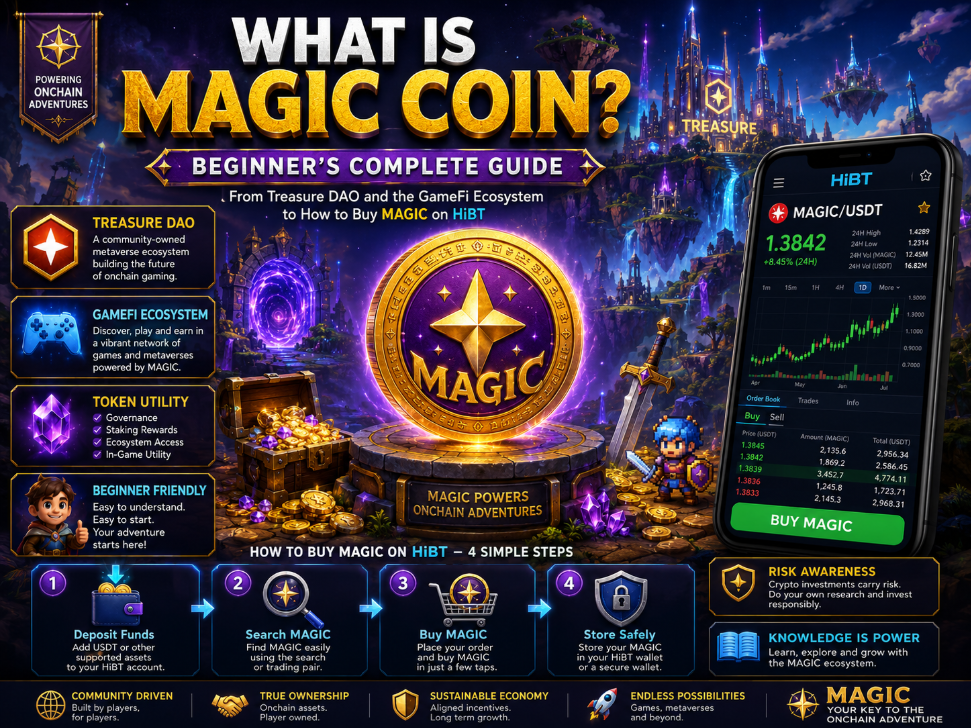
1. Which Project Issued MAGIC?
MAGIC is the native token of the Treasure ecosystem. Treasure initially developed as an NFT/GameFi project around the Loot ecosystem and gradually evolved into a decentralized gaming ecosystem tailored for on-chain games, NFTs, community governance, and ecological applications.
In its early narratives, Treasure was often referred to as the "decentralized Nintendo." The point of this phrase wasn't that Treasure wanted to replicate Nintendo's game content, but rather that it aimed to build a set of on-chain gaming infrastructure to:
- Help game projects integrate into a unified economic system;
- Use MAGIC to connect different games and NFTs;
- Drive ecosystem development through DAO governance;
- Provide marketplaces, identity, assets, and incentive tools for on-chain games;
- Allow different games to share assets, users, and liquidity.
Therefore, MAGIC is not a single consumable coin within one specific game; it is the core connective asset of the Treasure ecosystem.
2. What Does "Decentralized Nintendo" Mean?
The traditional gaming industry faces several obvious problems:
- Game assets usually belong to the platform, not truly to the players.
- Assets cannot flow freely between different games.
- After investing time and money, players find it hard to extract value out of the game.
- Publishing rights and resource allocation are highly centralized.
- Small indie developer teams struggle to acquire early users and liquidity.
The problem Treasure aims to solve is: Can on-chain games share an open economic system?
In Treasure’s vision, different games act like different worlds within the same universe:
- Players can migrate between multiple games.
- NFTs can become cross-game assets.
- MAGIC can serve as the unified medium of exchange within the ecosystem.
- The DAO can participate in ecosystem governance.
- Game developers can share the community, marketplace, and liquidity.
This is the core reason MAGIC was designed as an "ecological currency."
3. Why is MAGIC Called a Reserve Currency?
In Treasure’s early narrative, MAGIC was frequently called the ecosystem's reserve currency.
Think of it this way: Ordinary game tokens usually serve only one game. If a game’s popularity declines, the token demand drops rapidly. However, MAGIC’s goal isn’t to bind itself to a single game but to connect the entire Treasure ecosystem.
It can be used for:
- NFT trading;
- In-game economic activities;
- Ecosystem incentives;
- DAO governance;
- Staking and locking;
- Value transfer between different games and applications;
- Treasure's subsequent product and infrastructure scenarios.
Thus, MAGIC's core logic isn't "is a particular game fun," but rather "can the Treasure ecosystem sustainably attract games, players, developers, and liquidity."
4. What Does Running on Arbitrum Mean for MAGIC?
One of MAGIC's most important ecological foundations is Arbitrum. Arbitrum is an Ethereum Layer 2 network whose core values include:
- Transaction costs significantly lower than the Ethereum mainnet;
- Faster transaction speeds;
- EVM compatibility, making it easy for developers to migrate;
- Inheriting part of Ethereum’s security and user base;
- Highly suitable for high-frequency applications like gaming, NFTs, and DeFi.
For GameFi projects, deploying directly on Ethereum is too costly. So, Treasure choosing Arbitrum has several practical implications:
- Lowers the barrier to user participation;
- Enhances the on-chain operational experience;
- Better suited for NFT and gaming asset trades;
- Captures the attention of Arbitrum ecosystem users and capital;
- Forms an ecological network with Arbitrum-native projects like GMX and Camelot.
However, this also means MAGIC's performance is tied to the overall heat of the Arbitrum ecosystem. If Arbitrum's user growth slows, external attention on MAGIC may also decline.
5. How to Confirm You Are Looking at the Correct MAGIC?
Because the name "MAGIC" is so easily confused, beginners must learn to verify assets via contract addresses.
Key identification information for the MAGIC discussed in this article:
- Project: Treasure / Treasure DAO
- Token Name: MAGIC
- Network: Arbitrum
- Contract Address:
0x539bde0d7dbd336b79148aa742883198bbf60342 - Type: Native token of the Treasure ecosystem
- Main Attributes: GameFi / NFT / DAO / Arbitrum ecosystem token
Confusion targets to avoid:
- Magic Eden's ME token;
- Other small projects named Magic Token;
- Fake identical-name tokens on DEXs;
- Fake MAGIC recommended via social media DMs;
- Copycat assets with similar icons but different contract addresses.
II. What is Treasure DAO? Where Does MAGIC's Value Grow From?
1. The Origin of Treasure DAO
Treasure originally emerged from the Loot ecosystem. Loot was a highly unique NFT experiment—instead of traditional images, it provided a text-based inventory list (weapons, armor, accessories). Loot's open nature attracted many developers and community members to build derivative projects around it.
Treasure developed against this backdrop of open, community-driven, native on-chain assets. It gradually spun off from the Loot derivative ecosystem and established its own positioning:
- An ecosystem oriented towards on-chain games;
- An economic system built around MAGIC;
- A community organization driven by DAO governance;
- A platform connecting NFTs, games, players, and developers.
This is why MAGIC differs from ordinary blockchain game tokens. It wasn't a case of "build a game, then issue a coin"; rather, it was "build a community and ecosystem experiment, then gradually construct a multi-game, multi-app network around MAGIC."
2. What Are the Main Products and Games Within the Treasure Ecosystem?
The Treasure ecosystem has revolved around several games and NFT projects, including Bridgeworld, Smolverse, and Knights of the Ether.
- Bridgeworld: Bridgeworld was one of the earliest and most vital core games and economic systems for Treasure. It handled functions like MAGIC mining, NFT staking, and the flow of ecological resources. Think of it as the early economic engine of the Treasure universe.
- Smolverse: Smolverse represents the NFT and gaming direction with strong community culture attributes within Treasure, emphasizing characters, community, and lightweight experiences.
- Knights of the Ether: An early third-party blockchain game that entered the ecosystem, representing Treasure's ambition to attract external gaming teams.
- Treasure Marketplace: Treasure's native NFT trading market. Unlike a general market like OpenSea, it focuses specifically on internal ecosystem assets.
3. Treasure's Value Isn't Bound to a Single Game
When researching MAGIC, beginners often make the mistake of only watching to see if a single game goes viral. Instead, MAGIC's value should be observed from an ecosystem perspective.
You need to monitor:
- Can Treasure still attract new games?
- Are there real players within the ecosystem?
- Does the NFT market have trading volume?
- Are there real burn and lock-up scenarios for MAGIC?
- Is the DAO continuously advancing proposals?
- Is the team still shipping new products?
- Does the Arbitrum gaming ecosystem still need Treasure?
If Treasure is just an old NFT marketplace, MAGIC's imaginative upside is limited. If Treasure continues to be the gaming infrastructure on Arbitrum, MAGIC may regain market attention.
4. Treasure's Position in the Arbitrum Ecosystem
Treasure was once one of the most representative native projects on Arbitrum. Its importance came from:
- Early deep integration with Arbitrum;
- Bringing massive NFT and GameFi user bases;
- Being a vital experiment for the Arbitrum gaming ecosystem;
- Having MAGIC as a high-attention asset on Arbitrum;
- The Treasure Marketplace playing a significant role in Arbitrum NFT trading.
However, Arbitrum later developed many more projects across DeFi, DEXs, perps, RWAs, AI, and infrastructure. MAGIC is no longer the sole focus. This means MAGIC's future depends on whether it can maintain differentiation in an increasingly crowded Arbitrum ecosystem.
5. Has Treasure's Positioning Changed?
Early on, Treasure emphasized the Loot derivative ecosystem, NFT marketplaces, GameFi, the "decentralized Nintendo," and MAGIC as a reserve currency.
In its subsequent development, Treasure began exploring more directions: Treasure Chain, AI+Gaming, Agents, mobile apps, and broader gaming infrastructure.
This presents both opportunities and risks for MAGIC:
- Opportunities: New directions may bring new users and utility scenarios, freeing the ecosystem from relying solely on early NFT narratives.
- Risks: Pivoting might confuse veteran users, new products may fail, expansion drains capital, and MAGIC's value-capture mechanisms need to be re-understood by the market.
III. MAGIC Tokenomics: Why Was It Designed to Become "Scarcer With Use"?
1. What is MAGIC's Total Supply?
According to official Treasure documentation, MAGIC's total supply is 347,714,007 tokens.
This fixed supply is crucial because it means MAGIC cannot be minted infinitely. However, fixed supply does not guarantee price appreciation. The price still depends on:
- Circulating supply;
- Unlock schedules;
- Ecosystem demand;
- Market liquidity;
- Staking ratios;
- Exchange buy orders;
- Project revenue and user growth.
2. What Are the Characteristics of MAGIC's Emission Mechanism?
MAGIC's emission curve was designed somewhat like Bitcoin's halving, but on a shorter cycle. The core idea is:
- High early emission to bootstrap the ecosystem;
- Decreasing new output over time;
- Gradual emission reduction to create scarcity expectations;
- Using MAGIC to incentivize NFT, game, and ecosystem participation.
This design is highly attractive in a bull market. When user growth, NFT trading, and market sentiment rise simultaneously, MAGIC creates a compelling supply-and-demand story. But in a bear market, issues arise: user acquisition stalls, token demand drops, early adopters sell, and the market refuses to pay a high premium for a "future ecosystem."
3. How Should We View MAGIC's Allocation Structure?
When researching MAGIC, don't just memorize percentages; focus on these core questions:
- How many tokens flow to the community and ecosystem? If mostly used for incentives, it helps bootstrap the network. But if rewards don't translate into real retention, they will just be mined and dumped.
- Do the team and contributors have long-term lock-ups? Long-term lock-ups align the team with the ecosystem. Concentrated unlocks can cause massive sell pressure.
- How is the ecosystem fund used? Attracting high-quality games is bullish. Low capital efficiency will make the market question the DAO's competence.
- Can new emissions be absorbed by real demand? This is the ultimate test of tokenomics.
4. What is the Logic Behind MAGIC Mining and Staking?
In Treasure's early economy, MAGIC was closely tied to NFT staking and Bridgeworld. Early users could earn MAGIC by holding specific NFTs, participating in Bridgeworld, or providing liquidity.
- Pros: It connects NFTs, games, and tokens. Users are participating in an ecosystem, not just buying coins.
- Cons: If participants only want to farm and dump MAGIC, the system faces chronic sell pressure. The cycle is only healthy if users reinvest MAGIC into the ecosystem.
5. What Are the Burn or Lock-Up Scenarios for MAGIC?
Common scenarios include:
- Ecosystem NFT trading;
- In-game features and Bridgeworld economic activities;
- Staking or locking;
- DAO governance;
- Ecosystem app payments;
- Future usage on the Treasure Chain or AI/Agent-related features.
To judge if MAGIC is healthy, don't just ask "are there scenarios?", ask "is there real demand for these scenarios?"
6. How Does MAGIC Differ from AXS, GODS, and ILV?
While AXS, GODS, ILV, and MAGIC are all GameFi-related, their positioning differs.
- AXS relies heavily on the single Axie Infinity game.
- GODS relies on the Gods Unchained card game.
- ILV relies on Illuvium's game content.
- MAGIC is a multi-game ecosystem and infrastructure token.
MAGIC's Edge: It isn't entirely dependent on one game, has a higher imaginative ceiling, connects multiple NFTs, and is deeply tied to the Arbitrum ecosystem.
MAGIC's Weakness: The ecosystem is complex, making it hard for beginners to grasp. Multiple projects don't automatically mean high demand. Without a breakout hit game, token demand can easily languish.
IV. MAGIC Price History Review: What Truly Drives the Price?
1. How Did MAGIC Gain Early Traction?
MAGIC wasn't a coin that appeared out of nowhere on an exchange; it evolved from community, NFT, and on-chain gaming experiments. Early traction was driven by:
- The open narrative of the Loot ecosystem;
- Arbitrum early-adopter dividends;
- The massive NFT bull run and GameFi narrative explosion;
- Active trading on Treasure Marketplace;
- Bridgeworld attracting users;
- A strong, community-driven DAO vibe.
2. Why Did the Price Explode from Late 2021 to Early 2022?
The explosion was highly correlated with the macro environment. Key catalysts included:
- High GameFi capital activity;
- The market discovering the Arbitrum ecosystem;
- Treasure Marketplace generating real volume;
- Users willing to pay a premium for the future of on-chain gaming.
- When the market believed "Treasure could become the infrastructure for the on-chain gaming world," MAGIC's valuation naturally skyrocketed.
3. Why Did It Crash in the 2022 Bear Market?
The crash resulted from both macro market and sector-specific reasons.
- Macro: Fed rate hikes, shrinking crypto liquidity, risk asset sell-offs.
- Sector: Play-to-Earn faced a trust crisis, NFT liquidity dried up, poor blockchain game retention, and the market shifted from hype/narratives back to focusing on real revenue and users. MAGIC's ecosystem demand simply couldn't keep up with its early valuation.
4. Did MAGIC Benefit During the 2023–2024 Arbitrum Boom?
While Arbitrum garnered massive attention in 2023-2024 (DeFi, airdrops, L2 narratives), MAGIC didn't fully replicate the dominant performance of top DeFi tokens.
Why? The market's interest in GameFi was much weaker than DeFi. The NFT market was sluggish, and Treasure needed a new breakout hit. Investors remained cautious about long-term retention in blockchain games. An Arbitrum pump doesn't guarantee a MAGIC pump.
5. What Does the Distance from ATH Mean?
MAGIC is currently significantly drawn down from its All-Time High (ATH).
- Optimistic view: The drawdown is massive; if GameFi recovers or Treasure Chain succeeds, there is substantial rebound potential.
- Cautious view: "Down a lot" doesn't mean "cheap." The ATH was likely an NFT bull market bubble. Old projects easily get marginalized by new narratives. Without real user growth, a sustained price recovery is incredibly difficult.
V. Is MAGIC Still Alive? Judging Health via Real Ecosystem Metrics
1. What Metrics Prove MAGIC is Still Alive?
Many GameFi projects effectively die in bear markets. To research MAGIC, you must look beyond the price:
- Are official docs and Twitter/Discord updated?
- Is there still volume on Treasure Marketplace?
- Do ecosystem games still have players?
- Does MAGIC still have deep exchange liquidity?
- Are DAO proposals still advancing?
- Is GitHub or developer activity ongoing?
If these exist, the project isn't dead. But alive doesn't guarantee a price pump.
2. Does the Treasure Marketplace Still Have Value?
The marketplace was a core gateway. You must monitor:
- Stable monthly trading volume;
- Growth in active wallets;
- Floor prices of major NFT collections;
- Whether MAGIC remains a vital medium of exchange.
- If trading is chronically sluggish, MAGIC's ecosystem demand suffers.
3. Do the Ecosystem Games Have Real Users?
The most critical issue for GameFi isn't the token price, but real players. Check DAU (Daily Active Users), retention rates, in-game transactions, and community discussions. If the ecosystem only consists of investors and zero actual gamers, MAGIC remains purely speculative.
4. What Does MAGIC Staking Volume Indicate?
High staking ratios can indicate long-term holder confidence and reduced sell pressure. However, users might just be farming yields. If yields drop or unlocks happen, concentrated sell pressure can form. Staking data is a secondary metric, not a replacement for real user revenue.
5. What Does Mainstream Exchange Support Indicate?
If MAGIC is still trading on top exchanges, it maintains a market baseline, user attention, and liquidity. However, an exchange listing does not mean MAGIC will definitely rise or that the GameFi narrative has recovered. It is a necessary condition, but not a sufficient one.
VI. Six Risks You Must Face Before Investing in MAGIC
MAGIC is a high-risk asset. It is not suitable as a core holding for beginners.
- 1. GameFi Sector Decline Risk (Probability: High | Impact: High): The sector suffered because games weren't fun, token rewards were unsustainable, and players were just speculators. If GameFi remains sluggish, MAGIC will struggle.
- 2. Ecosystem Concentration Risk (Probability: Medium | Impact: High): If activity drops in core apps and new games fail to take the baton, MAGIC's utility weakens.
- 3. NFT Market Dependence Risk (Probability: Medium | Impact: Medium): A sluggish NFT market means lower trading volume and falling floor prices, reducing the need for MAGIC as a payment tool.
- 4. Arbitrum Ecosystem Competition Risk (Probability: Medium | Impact: Medium): MAGIC is competing for attention against GMX, new airdrops, AI, and RWAs on Arbitrum.
- 5. Liquidity Fragmentation Risk (Probability: Low to Medium | Impact: High): During panics, order book depth can thin out quickly. Large buys/sells will face severe slippage.
- 6. DAO Governance Inefficiency Risk (Probability: Medium | Impact: Medium): Community-driven decision-making can be slow, which is dangerous in a fast-paced gaming industry.
VII. How to Buy MAGIC on HiBT? A Step-by-Step Guide for Beginners
Note: The following is an operational guide, not a recommendation to buy. Start with a small amount only after completing your research.
1. Why Choose HiBT to Buy MAGIC?
For beginners, centralized exchanges are generally friendlier than Arbitrum DEXs. HiBT offers an intuitive interface, direct USDT trading, easy market/limit orders, and removes the immediate need to manage complex wallet private keys or manually import contract addresses.
2. Step 1: Register a HiBT Account
- Open the HiBT App or website.
- Register via email or phone.
- Set a strong password and complete the registration. (Never click phishing links).
3. Step 2: Enable Two-Factor Authentication (2FA)
Do not skip this. Immediately set up Google Authenticator, SMS/Email verification, and anti-phishing codes. Account security is more important than market timing.
4. Step 3: Complete KYC Verification
Prepare a valid ID and complete facial recognition. KYC satisfies compliance requirements, secures your account, and unlocks deposit/withdrawal limits.
5. Step 4: Deposit Funds
- Fiat Deposit: Use bank transfers or P2P (options vary by region).
- Crypto Deposit (e.g., USDT): If transferring from another wallet, always select the correct network (e.g., TRC20, ERC20, Arbitrum). Test with a small amount first.
6. Step 5: Buy MAGIC
- Search for MAGIC in the spot trading section.
- Select the MAGIC/USDT pair.
- Choose between a Market Order (executes immediately at current price, risk of slippage) or a Limit Order (you set the exact price).
- Enter the amount and confirm the order.
- For high-volatility assets like MAGIC, Limit Orders are highly recommended to control costs.
7. Post-Purchase Management
- HiBT Account: Best for small holdings and active trading.
- MetaMask (Arbitrum One Network): Best if you want to stake, play games, or interact with the Treasure ecosystem. (Keep your seed phrase safe!).
- Cold Wallet: Best for large, long-term holdings.
VIII. Who is MAGIC Suitable For? A Suitability Checklist
1. MAGIC is Riskier Than BTC, ETH, and SOL
BTC is digital gold; ETH is infrastructure; SOL is a high-performance app ecosystem. MAGIC is a small-cap, high-volatility, ecosystem-dependent GameFi/NFT token. It is highly sensitive to project updates and market narratives.
2. Suitable User Profile
- Understands the Arbitrum ecosystem.
- Has independent judgment on GameFi/NFTs.
- Willing to track Treasure ecosystem data.
- Can tolerate a 70%+ max drawdown.
- Only uses small satellite positions.
- Strictly sets stop-loss and take-profit targets.
3. Unsuitable User Profile
- Absolute crypto beginners.
- Hasn't established a base BTC/ETH portfolio yet.
- Cannot stomach massive volatility.
- Uses short-term living expenses for trading.
- Buying purely to "buy the dip" without research.
4. Portfolio Allocation Strategy
- Conservative (0%–2%): Observe only. If buying, use an extremely small position.
- Balanced (2%–5%): Treat MAGIC as a high-risk satellite position, not core holdings.
- Aggressive (5%–10%): Only for those deeply involved in the Treasure ecosystem who can read on-chain data and DAO proposals. Not recommended for beginners.
5. When to Take Profits or Exit?
- Take Profit Triggers: Massive short-term pumps, price nearing major resistance, or the broader market (BTC) showing clear top signals.
- Exit/Stop-Loss Triggers: Treasure ecosystem stagnation, core game users consistently dropping, liquidity drying up, or the original reason you bought no longer holds true.
IX. Is MAGIC Still Worth Buying?
There is no simple "yes" or "no." It depends entirely on your logic.
- If you believe in a GameFi recovery: MAGIC is a top research target due to its strong community, multi-game narrative, and position in Arbitrum.
- If you want stable allocation: MAGIC is a poor choice. Stick to BTC, ETH, SOL, and mature Layer 2s or DeFi protocols.
- If you are a short-term trader: There are volatility plays to be made, but you must strictly monitor volume, order book depth, and Arbitrum ecosystem news.
- If you are a beginner: Do not go heavy. Understand the project, check contract addresses, test the buying process with tiny amounts, use limit orders, and never use leverage.
If you are still researching different types of high‑volatility assets, you can also compare the logic of the Meme coin sector. For example, on HiBT, the complete guides What is PEPE? From Meme Coin Logic, Surge Reasons, Risks to Purchase Process and What is WIF? From dogwifhat Origin, Solana Meme Coin Logic, Risks to Purchase Process, as well as the WIF 2030 Price Prediction, can help you understand the differences between GameFi tokens and Meme coins in terms of narrative, risk, and capital drivers.
Conclusion: MAGIC Requires Deep Research, Don't Follow Blindly
To summarize MAGIC in three sentences:
- MAGIC is the native token of the Treasure ecosystem; it is not a normal in-game prop, but a value medium connecting games, NFTs, DAOs, and the Arbitrum ecosystem.
- It gained massive value by building a unique multi-game narrative during the NFT/GameFi boom and holding a pivotal early position on Arbitrum.
- Its current core challenges are the cooling GameFi sector, sluggish NFT market, uncertain ecosystem app growth, and the pressure of DAO execution efficiency.
Therefore, MAGIC is not for everyone. It is best suited for users capable of researching GameFi, Arbitrum, and DAOs, treating it as a high-risk observation position. If you wish to proceed, register on HiBT, observe the market, and only participate with a small amount once you fully understand the mechanics, risks, and exit strategies.
FAQ: MAGIC Coin
What is MAGIC coin?
MAGIC coin is the native token of the Treasure ecosystem. Operating primarily on the Arbitrum network, it connects games, NFTs, DAO governance, and apps within the ecosystem. It is an ecological token, not a single in-game prop.
What is the relationship between the MAGIC token and Treasure DAO?
Treasure DAO is the ecological organization behind MAGIC, and MAGIC is the core token. Treasure uses MAGIC to connect game projects, NFT marketplaces, players, developers, and community governance.
Which blockchain does MAGIC run on?
MAGIC's most important network is Arbitrum (an Ethereum Layer 2). Pay strict attention to the network and contract address to avoid buying fake tokens.
Is MAGIC coin still worth buying?
This depends on your outlook for the Treasure ecosystem, the potential recovery of GameFi, and Arbitrum gaming infrastructure. It is not recommended for conservative beginners to hold large positions.
Where can I buy MAGIC coin?
MAGIC is available on select centralized exchanges and on-chain DEXs. Ensure the platform supports the MAGIC/USDT pair and verify the contract address. Beginners are better off learning via centralized exchanges like HiBT first.
What is the total supply of MAGIC?
The total supply is 347,714,007 tokens. While a fixed supply establishes scarcity, price ultimately depends on circulating supply, ecosystem demand, liquidity, and project progress.
How do I buy MAGIC on HiBT?
Register on HiBT, complete KYC, deposit USDT, search for MAGIC in the spot trading section, select the MAGIC/USDT pair, and buy using a Market or Limit order. Due to high volatility, Limit Orders are highly recommended to control costs.
What is the difference between MAGIC and other identically named tokens?
The token discussed here is the Treasure DAO MAGIC token (contract: 0x539bde0d7dbd336b79148aa742883198bbf60342) on Arbitrum. Always verify the official contract address before buying to avoid purchasing copycat or unrelated assets with similar names.