
When many people first see CXMTUSDT on a crypto trading platform, their immediate reaction is often: Is CXMT a newly issued coin? What does it have to do with Changxin Memory? And why would a Chinese A‑share semiconductor company suddenly appear in the USDT perpetual contract market?
The answer is: CXMTUSDT is not a cryptocurrency in the ordinary sense, nor is it “Changxin Memory issuing a Token.”
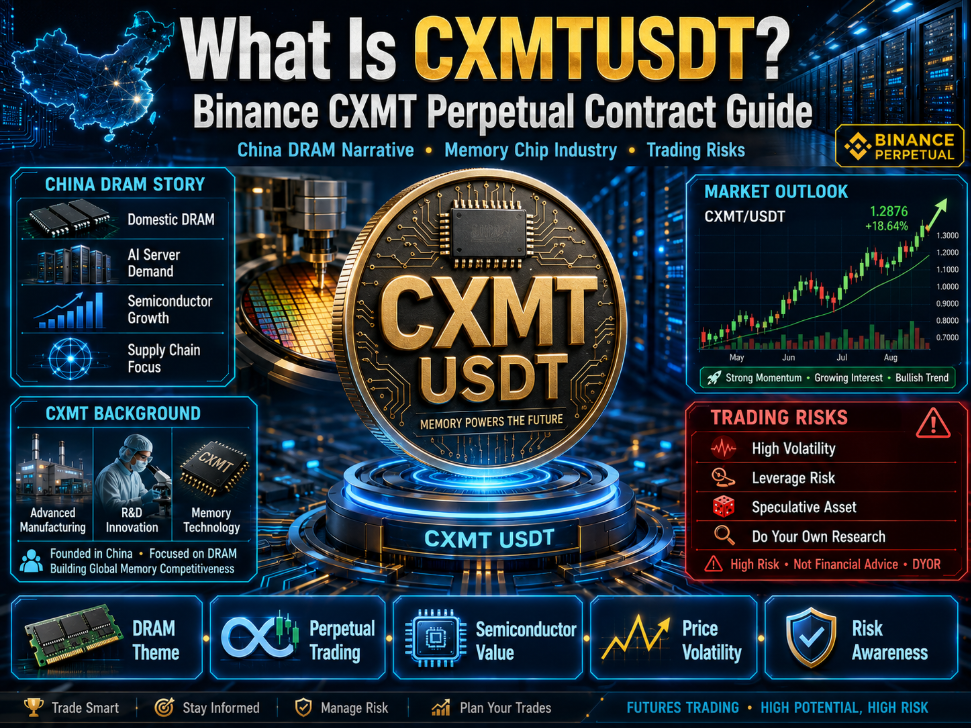
CXMTUSDT is a USDT‑denominated TradFi Perpetual Contract launched by Binance Futures on August 18, 2026. Its underlying reference asset is Changxin Technology Group Co., Ltd., listed on the Shanghai Stock Exchange with the stock code 688825. Binance’s official announcement states that the CXMTUSDT contract supports up to 20× leverage, trades 24/7, has a funding rate settlement every 8 hours, and – because Changxin Technology’s A‑shares are priced in RMB – the contract applies a real‑time USDT/CNH exchange rate for price conversion.
This means that when users trade CXMTUSDT, they are essentially trading contract exposure to the price movements of Changxin Technology’s stock in the crypto derivatives market – not buying a crypto coin called CXMT.
Nor should it be simplistically understood as:
Buying CXMTUSDT = Buying Changxin Technology stock.
While the two are price‑related, they differ in asset ownership, trading hours, leverage, funding rates, currency risk, and pricing mechanisms.
What truly makes CXMTUSDT noteworthy is not just that Binance listed another new contract.
It simultaneously connects several major 2026 capital‑market narratives:
Domestic DRAM, AI infrastructure, the memory chip cycle, and the entry of TradFi assets into the crypto derivatives space.
For investors who follow both semiconductors and crypto, CXMTUSDT is effectively a new trading instrument born at the intersection of these trends.
Why Did CXMTUSDT Suddenly Become a New Trading Asset in Crypto Markets?
Before CXMTUSDT appeared, a crucial prerequisite had already changed:
Changxin Technology officially became a publicly traded company.
According to Shanghai Stock Exchange records, Changxin Technology Group Co., Ltd. has the securities code 688825 and an IPO price of 8.66 RMB/share; the exchange confirmed that the company debuted on the STAR Market on July 27, 2026.
In the past, when investors discussed “Changxin Memory stock” or “CXMT stock,” a very real problem was that the company had no public A‑share price.
After the listing, that problem disappeared.
The market now has a publicly traded underlying asset:
688825 Changxin Technology.
Shortly thereafter, Binance Futures published an announcement on August 17, 2026, stating that CXMTUSDT USDT‑Priced Perpetual Contract would officially go live on August 18, 2026, at 05:00 UTC.
Its official parameters include:
- Underlying asset: CXMT Corporation, Shanghai Stock Exchange code 688825;
- Settlement asset: USDT;
- Minimum notional value: 5 USDT;
- Maximum leverage: 20×;
- Funding rate cap and floor at ±2%;
- Funding rate settlement every 8 hours;
- 24/7 trading;
- Use of third‑party real‑time USDT/CNH exchange rates.
So CXMTUSDT did not appear because “Changxin issued a coin.”
A more accurate understanding is:
Once an A‑share semiconductor company gained a public market price, a crypto platform launched a 24/7 tradable perpetual derivative based on that traditional financial asset.
This is also a typical recent example of the ongoing convergence between TradFi and crypto trading infrastructure.
What Exactly Is CXMTUSDT? Breaking Down CXMT, USDT, and Perpetual in One Minute
If you are new to this type of product, you can break CXMTUSDT into three parts.
What Does CXMT Mean?
Here, CXMT refers to Changxin Technology Group Co., Ltd. – the listed entity associated with the market‑known Changxin Memory.
Changxin’s official website now directly displays the securities code 688825, and the copyright holder on the site is clearly “Changxin Technology Group Co., Ltd.” At the same time, the company continues to use “Changxin Memory” as its external brand name.
So when investors search for:
“Changxin Memory stock,” “Changxin Technology stock,” “CXMT stock,” “Changxin Technology 688825,”
they are all essentially referring to this listed company and its DRAM business.
What Does USDT Mean?
USDT is the margin, profit/loss calculation, and settlement asset for this perpetual contract.
When you trade CXMTUSDT, you do not need to directly prepare RMB to buy 688825 shares. Instead, you use USDT as margin to establish a contract position.
It is important to understand:
Margin is not principal used to buy the stock.
It is collateral to maintain a derivatives position.
If you use leverage, your actual notional position may be larger than the margin you put up.
What Does Perpetual Mean?
Perpetual Futures are exactly that – perpetual contracts.
Unlike traditional futures with fixed expiry dates, they have no preset expiration.
In theory, as long as your position is not liquidated, margin is sufficient, and platform rules are met, you can continue to hold it.
But “no expiration” does not mean “suitable for perpetual holding.”
Because perpetual contracts also involve:
- Funding rates;
- Leverage risk;
- Liquidation risk;
- Basis risk;
– all of which create holding costs and risks over the long term.
Is CXMTUSDT the Same as Changxin Technology Stock?
No.
This is the most critical point to understand about CXMTUSDT.
When you buy 688825 through a securities account on the Shanghai Stock Exchange, you obtain a stock position.
When you trade CXMTUSDT, you hold a:
Binance TradFi Perpetual Futures contract position.
Binance officially defines TradFi Perps as perpetual futures based on traditional assets. Although their price index references the underlying traditional asset market, their margin and settlement mechanisms follow perpetual futures rules.
Therefore, buying CXMTUSDT cannot be simplified as:
“I bought one share of Changxin Technology.”
Nor do you automatically acquire the full shareholder rights that traditional stock investors have, simply because you hold CXMTUSDT.
For example:
- It does not put you on Changxin Technology’s shareholder register;
- It does not grant A‑share voting rights;
- It is not a way to withdraw real 688825 shares to a wallet;
- It should not be understood as ordinary stock spot.
For corporate actions such as dividends, you should refer to the contract platform’s specific adjustment mechanisms, rather than applying the traditional “shareholder dividend” understanding from a securities account. Binance has separate corporate action and dividend adjustment rules for equity‑based TradFi perpetuals.
Is CXMTUSDT a Tokenized Stock or RWA?
At a high‑level narrative level, it does fall into the category of crypto merging with traditional financial assets.
But if we distinguish financial product structures precisely:
CXMTUSDT is closer to a crypto derivative of a traditional stock price, rather than a Tokenized Stock that represents actual ownership of the stock.
These two concepts should not be confused.
A true tokenized stock or equity‑type RWA product typically requires further confirmation:
Does the token have stock backing? Who is the custodian? Is it redeemable? Does it carry economic rights?
CXMTUSDT, on the other hand, is first and foremost a:
Perpetual Futures Contract.
So a more accurate classification is:
TradFi Perpetual Contract.
Not CXMT Coin, and certainly not an official crypto token issued by Changxin Technology.
Who Is Changxin Technology? What Is the Relationship Between Changxin Memory and Changxin Technology?
To understand CXMTUSDT, we must ultimately return to its underlying company.
According to Changxin’s official materials, the company was founded in 2016, is headquartered in Hefei, Anhui, and is an integrated memory manufacturer focused on DRAM, covering the design, R&D, manufacturing, and sales of DRAM chips. Its products are used in mobile terminals, PCs, servers, virtual reality, and IoT.
In simple terms:
Changxin does not merely design chips.
It also involves:
Design → R&D → Manufacturing → Sales.
This differs from some Fabless companies that only design chips and outsource manufacturing to foundries.
“Changxin Memory” has long been the well‑known brand name in the market, while the listed entity is now:
Changxin Technology Group Co., Ltd.
The copyright holder on Changxin’s official website is already clearly Changxin Technology Group Co., Ltd., while the company continues to use “Changxin Memory” as its external brand expression.
So from an investment and SEO search perspective:
“Changxin Memory stock” and “Changxin Technology stock 688825” are now highly correlated.
What Exactly Does Changxin Technology Sell? From DDR4, DDR5 to LPDDR5X
Changxin’s core products are not CPUs or GPUs, but rather:
DRAM.
Its current official product portfolio already covers:
DDR4, DDR5, LPDDR4X, LPDDR5/5X,
among other DRAM products.
One particularly notable product is DDR5.
Changxin’s official data shows that its DDR5颗粒 (die) now reaches peak speeds of over 8000 Mbps, with die capacities covering 16Gb and 24Gb, and the company has launched various module products for servers, workstations, desktops, and laptops.
On the mobile side, Changxin’s LPDDR5X officially announced peak speeds have reached 10667 Mbps.
These product developments are very important.
Because they mean that when investing in CXMT, one can no longer simply view the company as:
“A low‑end domestic memory substitute.”
Instead, the key question is whether the company can continue to enter higher‑performance, higher‑capacity, and higher‑value DRAM markets.
What Is DRAM, and Why Is It Indispensable in the AI Era?
If you think of a server as a work team:
The CPU and GPU are more like the brains performing complex calculations.
DRAM, on the other hand, is like:
A high‑speed working memory right next to the brain.
During computations, large amounts of data cannot be read repeatedly from slower long‑term storage devices.
Therefore, the system needs DRAM to temporarily store the data being processed.
That is the meaning of “Dynamic Random Access Memory.”
For example, when an AI server runs a large model, the entire computational process may involve:
Data entering → CPU processing → GPU acceleration → Memory fast read/write → GPU fetching data again → Network transmission → Next round of computation.
Thus, as AI models grow larger and server counts increase, the demands on memory in terms of:
Capacity, Speed, Bandwidth, Power consumption,
all rise accordingly.
This is why “AI chip investing” cannot focus solely on GPUs.
From an infrastructure perspective:
GPUs solve compute power; High‑speed networks solve data transmission; DRAM and HBM solve the critically important data access problem during computation.
Is AI Growth Really Driving DRAM Demand?
At least from 2026 industry data, AI has indeed become a significant variable in DRAM supply and demand.
In its Q2 global DRAM study published in August 2026, Counterpoint Research pointed out that AI infrastructure growth is driving demand for both conventional DRAM and HBM; it believes that Agentic AI and AI server CPU growth may continue to boost traditional DRAM demand.
TrendForce also noted in 2026 that server demand remains strong and expects AI server demand to continue supporting memory prices.
So the CXMT investment thesis does contain the chain:
AI Infrastructure → Server Expansion → DRAM Demand Growth.
However, an important limitation must be added.
An increase in AI demand does not mean that all DRAM companies will benefit proportionally.
Ultimate profitability still depends on:
Product mix, Selling prices, Costs, Capacity, Yield, Customer structure,
and other factors.
Why Does Changxin Technology Become the Core Narrative for “Domestic DRAM”?
Changxin attracts capital market attention not just because it is a semiconductor company.
More importantly:
The global DRAM industry is itself highly concentrated.
In Counterpoint’s Q2 2026 data, Samsung held about 39% of the global DRAM market, SK hynix about 26%, Micron about 25%; CXMT was called the fastest‑growing DRAM supplier in the quarter, with 716% year‑over‑year growth, mainly driven by domestic Chinese demand and capacity expansion.
This means that the global DRAM market has long formed a highly concentrated oligopoly.
Therefore, a Chinese company capable of building large‑scale DRAM design and manufacturing capability inherently possesses significant industrial scarcity.
Domestic DRAM Thesis #1: China Itself Has Enormous End‑Demand
China’s market has a vast manufacturing chain for:
Smartphones, PCs, Servers, Data centers, Automotive electronics, Consumer electronics,
and almost all of these devices require memory chips.
If domestic DRAM vendors can continuously improve:
Product performance, Output, Customer qualification rates,
then theoretically, there is a very large domestic demand market.
This is the first layer of the “domestic substitution” logic often discussed in the market.
Thesis #2: Supply Chain Localization
Semiconductors are no longer just a consumer electronics industry.
They also involve:
Supply chain security, Advanced manufacturing, Data centers, Artificial intelligence,
and other strategic sectors.
In this context, the importance of domestic DRAM production capability has increased markedly.
But one must especially avoid the simplistic leap of:
Domestic = guaranteed success.
This is a very dangerous logical jump in investment analysis.
What really determines a company’s competitiveness remains:
Can it make the product? Can it mass‑produce? Is yield high enough? Does product performance meet customer requirements? Is cost competitive? Are customers willing to keep buying?
Industrial policy can create opportunities.
But business competition ultimately still comes down to the product.
Thesis #3: The DDR5 Upgrade Cycle
As server and PC platforms upgrade:
DDR4 is gradually migrating to DDR5.
For memory vendors, this means the industry is not simply selling the exact same products indefinitely.
The product mix is changing.
If Changxin can gain more customers and orders in DDR5:
Its competitiveness and product value could improve.
Changxin has already publicly demonstrated DDR5 products with speeds up to 8000 Mbps, covering server and PC applications – at least indicating that the company’s product roadmap is moving toward next‑generation DRAM.
Who Are Changxin Technology’s Real Competitors?
CXMT does not grow in a market without competitors.
It faces some of the strongest companies in the global semiconductor industry.
Samsung: The Global Integrated Memory Giant
Samsung has DRAM, NAND, and enormous semiconductor manufacturing capability.
In Q2 2026, Counterpoint reported that Samsung regained the No. 1 spot in global DRAM with about 39% market share.
Its advantages are not only scale, but also:
Advanced process technology, Customer relationships, Product portfolio, Capital expenditure capacity.
SK hynix: A Key Player in AI Premium Memory
In recent years, SK hynix’s biggest market attention has come from HBM.
HBM is critical high‑bandwidth memory for AI GPUs and AI acceleration systems.
Thus, SK hynix’s competitiveness stands out more in:
Premium DRAM, HBM, The AI server supply chain.
Counterpoint estimated its Q2 2026 DRAM market share at about 26%.
Micron: The Major U.S. DRAM Player
Micron is one of the world’s most important memory manufacturers.
Counterpoint placed its Q2 2026 global DRAM share at about 25%, very close to SK hynix.
Where Is CXMT’s Biggest Opportunity?
CXMT’s main growth logic leans more on:
Domestic Chinese demand, Local supply chains, Capacity expansion, DDR5 upgrades, AI server demand, And future improvements in high‑end product capabilities.
Counterpoint even noted that it is worth watching whether CXMT can use its IPO proceeds to expand capacity and capabilities in areas like HBM and LPDDR6.
But this also means:
The market is now trading not just the company’s existing capabilities.
It also incorporates a considerable amount of:
Future growth expectations.
Why Doesn’t CXMTUSDT’s Price Always Equal Changxin Technology’s A‑Share Price?
This is one of the most important aspects to understand about CXMTUSDT.
Many newcomers might think:
If Changxin Technology’s A‑share price is 100 RMB, then CXMTUSDT should simply equal 100 USDT.
In reality, it does not work that way.
Binance’s official rules state that for China‑stock TradFi perpetual contracts, the price index uses the offshore USDCNH exchange rate to convert and translate into USDT.
Therefore, CXMTUSDT is influenced by at least the following variables.
First: Changxin Technology 688825 Spot Price
This is the most core variable.
If 688825 rises significantly during Shanghai trading hours:
CXMTUSDT will generally be affected as well.
If the stock falls:
The contract will likewise be repriced.
So when analyzing CXMTUSDT:
Do not only look at the crypto K‑line.
You must first look at Changxin Technology’s A‑share price.
Second: The RMB Exchange Rate
Changxin Technology stock is traded in RMB.
CXMTUSDT is denominated and settled in USDT.
The process requires:
RMB price → Exchange rate conversion → USDT price.
Binance’s listing announcement specifically notes that CXMTUSDT uses a third‑party, real‑time USDT/CNH exchange rate.
So even if the RMB share price of Changxin Technology does not change significantly:
If the offshore RMB exchange rate moves notably,
the USDT‑denominated price of CXMTUSDT could theoretically be affected.
Third: The Perpetual Contract Funding Rate
CXMTUSDT is not spot.
It has a Funding Rate.
At launch, Binance announced:
Funding rate settlement every 8 hours, with an initial cap and floor of ±2%.
If a large number of traders are all long:
The funding rate may increase.
Even if the price does not ultimately decline:
Holding a long position over time may incur additional costs due to funding.
Conversely:
In some market environments, shorts may also pay funding to longs.
So:
Correct directional judgment does not guarantee final profit.
Trading costs matter just as much.
Fourth: Crypto Markets Can Still Trade After A‑Share Close
This may be the most striking difference between CXMTUSDT and buying 688825 directly.
Changxin Technology A‑shares are not traded 24 hours.
Binance’s official reference trading hours for China stocks are Beijing time:
09:30 – 11:30
and
13:00 – 14:57.
But CXMTUSDT itself supports:
24/7 trading.
To address the issue of the underlying A‑share market being closed while the perpetual continues trading, Binance uses an Orderbook EWMA mode to calculate the index price during Chinese stock market closure.
This is very important.
What Is CXMTUSDT Actually Trading During A‑Share Market Close?
For example:
After A‑shares close on Friday,
suddenly a major piece of news breaks:
Changxin wins a key customer; DRAM prices surge; A major semiconductor policy change occurs; Or conversely, a significant negative development for the company.
The 688825 stock cannot be immediately repriced because the exchange is closed.
But CXMTUSDT can still be traded.
So crypto traders will start:
Buying or selling the contract.
At that point, CXMTUSDT may price in the new information ahead of the market.
Binance’s official mechanism shows that during Chinese stock market closures, weekends, and holidays, the index enters Orderbook EWMA mode; for equity‑based TradFi contracts on weekends and holidays, there are also corresponding index/mark price deviation limits.
This can create a very interesting phenomenon:
Crypto perpetuals trade expectations first → A‑shares reopen → the two markets converge in price.
But this mechanism also amplifies risk.
Because during closure:
There is no real A‑share spot trading to provide instant calibration.
Why Does CXMTUSDT Deserve Attention? What You’re Really Trading Are Four Industrial Threads
If you view CXMTUSDT simply as “another Binance contract,” you might underestimate the asset logic behind it.
The factors that truly determine CXMT’s long‑term relevance are mainly four themes.
Thread 1: Domestic Semiconductors
Changxin’s most obvious industrial label is:
Chinese DRAM manufacturing.
If in the future:
Domestic DRAM share rises; Customer base expands; Capacity increases; Products upgrade; Profitability improves,
the market may assign a higher valuation to Changxin.
But the biggest validation metric for this logic is not:
The number of news headlines.
It is:
Financial data and market share.
Thread 2: AI Infrastructure
AI compute demand is reshaping the entire semiconductor supply chain.
In the past, the market focused most on:
GPU.
But as AI server scale expands:
Storage, Networking, Power, Optical communications,
and other segments have also begun to attract attention.
This is why investors are gradually moving from:
“Buying AI chips”
to:
“Investing in the entire AI infrastructure.”
Changxin belongs to the:
Storage segment.
Thread 3: The DRAM Industry Cycle
Changxin itself explicitly states that DRAM has distinct commodity‑like properties and price cycles.
This is a factor that cannot be ignored when analyzing CXMT.
When DRAM is in short supply:
Prices rise.
Memory manufacturers’:
Revenue, Gross margin, Profit,
may improve significantly.
But if the entire industry expands capacity simultaneously:
Supply increases.
That may lead to:
Price declines → margin compression.
Thus, memory companies tend to be distinctly cyclical.
This means:
One cannot assume DRAM prices will rise forever just because of long‑term AI demand growth.
Thread 4: TradFi Is Entering Crypto Trading Platforms
CXMTUSDT also has an investment theme independent of Changxin’s fundamentals:
Crypto platforms are expanding the range of traditional assets available for trading.
More and more users now want:
To trade in one account:
BTC, ETH, Stocks, ETFs, Gold, Commodities.
TradFi Perpetuals are designed precisely to meet that demand.
So CXMTUSDT simultaneously carries:
A domestic semiconductor asset narrative + a crypto TradFi derivatives narrative.
How to Buy CXMTUSDT? Using HIBT’s TradFi Trading Process as an Example
First, it is important to note that availability, maximum leverage, funding rates, and regional accessibility may differ across platforms.
Therefore, if HIBT has already opened CXMTUSDT or the corresponding Changxin Technology TradFi perpetual, you can follow the general process below.
Step 1: Register and Set Up Security
Go to HIBT and complete account registration.
Then it is recommended to complete:
Identity verification; Google Authenticator; Two‑factor authentication; Fund security settings.
Especially when preparing to trade perpetual contracts:
Account security is no less important than your trading strategy.
Step 2: Prepare USDT Margin
TradFi perpetual contracts generally use USDT as margin.
For example, you prepare:
100 USDT.
This does not mean “you have bought 100 USDT worth of Changxin Technology stock.”
It means:
You are using 100 USDT as contract margin.
If using 3× leverage:
The notional position would be roughly 300 USDT.
So it is essential to distinguish between:
Margin
and
Position value.
Step 3: Enter HIBT’s Contract or TradFi Trading Area
Search for:
CXMT
or:
CXMTUSDT.
Then check:
Contract name; Underlying reference asset; Current price; Funding rate; Maximum leverage; Minimum order size.
In particular, confirm that the product is a:
Perpetual Contract.
Do not confuse:
Crypto spot, Stock tokens, and Perpetual contracts.
Step 4: Choose Long or Short
If you believe:
Changxin Technology’s price is likely to rise in the future,
you may consider going Long.
If you think:
The DRAM cycle is turning down; The company is overvalued; The semiconductor sector is weakening; Or the stock is due for a correction,
the perpetual contract also allows you to express a bearish view via Short.
This is one of the biggest differences between derivatives and traditional one‑way stock ownership.
Step 5: Just Because 20× Is Available, Doesn’t Mean You Should Use It
Binance’s CXMTUSDT launch supported up to 20× leverage.
But:
The maximum leverage allowed by the platform is not necessarily the leverage suitable for you.
For example:
100 USDT principal.
Using 3× leverage:
Notional position about 300 USDT.
If the underlying moves 5% against you:
Notional loss about 15 USDT, excluding fees, funding, and specific margin rules.
If you increase leverage to 20×:
The same underlying price move would have a much larger impact on your account margin.
This is why high‑leverage perpetuals can result in:
The direction being correct in the end,
but getting liquidated first along the way.
Step 6: Set Stop‑Loss and Manage Liquidation Risk
For CXMTUSDT, you should at least monitor:
Entry price; Stop‑loss price; Liquidation price; Margin ratio; Funding rate.
In particular, avoid this typical mindset:
“I’m bullish on Changxin long‑term, so a short‑term dip doesn’t matter.”
If you are trading stock spot:
that logic at least has room for discussion.
But if you are trading a high‑leverage perpetual contract:
The market may not give you time to wait for the long‑term thesis to play out.
Is CXMTUSDT Suitable for Long‑Term Holding?
In theory, perpetual contracts have no traditional expiry date.
But that does not mean they are naturally suitable for long‑term investing.
There are three reasons.
First: Funding Rates Can Continuously Incur Holding Costs
If the funding rate is persistently against your position direction:
Fees accrue every 8 hours.
The longer you hold:
The higher the cumulative cost.
So even if Changxin’s stock price rises 50% six months later:
Your final return cannot be calculated solely from:
Entry price and exit price.
Second: Leverage Amplifies Path Risk
Suppose you predict:
Changxin will rise 50% over the next year.
And it indeed rises 50% in the end.
But along the way it first drops:
20%.
If your leverage is very high:
you may be liquidated before the actual rally.
This is:
Correct direction, but failed trade.
Third: CXMTUSDT Also Has Basis Risk and Closure‑Period Price‑Discovery Risk
When A‑shares are closed:
the contract is still trading.
This means the contract price and the underlying A‑share price may deviate more complexly in the short term.
Therefore:
“Bullish on Changxin Technology’s long‑term value”
and
“Suitable for long‑term holding of CXMTUSDT perpetual”
are two completely different questions.
How Should You Analyze CXMTUSDT Price? Build a Five‑Core Indicator Framework
To judge CXMTUSDT’s future moves, it is not advisable to stare only at the crypto K‑line.
You can establish a five‑layer observation framework.
1. Changxin Technology 688825 Stock Price
This is the most direct variable.
The underlying reference asset of CXMTUSDT is Changxin Technology.
So first observe:
Direction after A‑share market opens; Volume; Valuation; Company announcements; Earnings reports.
If the underlying stock shows clear moves:
the contract cannot ultimately deviate from the spot fundamentals for long.
2. DRAM Prices
Changxin is fundamentally a DRAM company.
So you need to pay close attention to:
DDR4 prices; DDR5 prices; Server DRAM; LPDDR.
When DRAM is in an upcycle:
memory companies’ profitability is usually more easily re‑rated by the market.
Conversely:
if prices enter a downcycle,
even if shipment volumes increase,
profit performance may still be under pressure.
3. AI Server Demand
Watch:
Cloud capex; AI server shipments; Data center construction; Server memory configurations.
If each server requires more DRAM,
and server counts keep growing,
the entire memory market demand could be supported.
Counterpoint’s Q2 2026 study already cited AI adoption and AI server CPU growth as important drivers of DRAM demand.
4. Changxin Technology Fundamentals
For long‑term researchers, ultimately one must return to:
Revenue; Gross margin; Net profit; R&D spending; Capex; Capacity; Product mix.
If:
the stock price has multiplied several times,
but profits have not improved correspondingly,
valuation risks will keep rising.
Conversely:
if earnings growth can consistently exceed market expectations,
the market may be willing to assign a higher valuation.
5. Crypto Derivatives Market Structure
For short‑term CXMTUSDT trading, you also need to look at:
Funding Rate; Open Interest; Long/Short Ratio; Volume; Liquidation data.
For example:
company fundamentals have not changed,
but the market suddenly sees a flood of 20× leveraged long positions.
That alone can alter short‑term risk.
Because if the price moves down,
liquidations may trigger cascading sells.
So:
Short‑term CXMTUSDT = Stock fundamentals + Crypto derivatives structure.
What Is the Relationship Between CXMTUSDT and BTC or ETH?
Strictly speaking:
CXMTUSDT is not a Bitcoin or Ethereum ecosystem asset.
Its most important fundamentals still come from:
Changxin Technology, DRAM, and the semiconductor industry.
Therefore:
BTC rising does not mean CXMT will necessarily rise.
ETH rising does not mean Changxin Technology’s stock will necessarily rise.
However, because CXMTUSDT trades on crypto derivatives platforms:
overall market risk appetite can still indirectly affect leverage and fund flows.
For example, during a broad crypto deleveraging event:
many traders reduce risk positions.
In that context, you can observe overall crypto liquidity changes via Bitcoin price trends and BTC market cycle forecasts.
Similarly, you can use ETH future price trends and Ethereum market analysis to gauge whether mainstream crypto risk appetite has materially worsened.
But the analytical priority should be clear:
CXMT fundamentals > DRAM industry > A‑share market > Crypto risk appetite.
Not the other way around.
What Is the Difference Between CXMTUSDT and WDCON? Same Storage Sector, But Different Investment Logic
If you wish to compare similar assets, you may first look at Western Digital‑related products.
You can continue reading:
What Is WDCON USDT? Western Digital Tokenized Asset and the AI Storage Cycle Explained
Both can be affected by global storage industry changes.
However, Changxin Technology is more focused on:
DRAM, Domestic semiconductors, and the Chinese supply chain.
Western Digital has a different product mix, geographical markets, and company fundamentals.
Therefore:
Just because both carry the “storage” label does not mean their price performance should be perfectly synchronized.
CXMTUSDT and LITEON: One Is Storage, the Other Is AI High‑Speed Connectivity
The AI server supply chain requires not only GPUs and memory.
It also needs:
High‑speed optical communications, Switching equipment, and network connectivity.
Therefore, another AI infrastructure research direction is optical communication assets.
You can read, for example:
What Is LITEON USDT? AI Optical Communications and Data Center Asset Logic
The two can be understood as:
CXMT focuses on:
How data is stored and accessed at high speed.
LITEON‑related assets focus more on:
How data is transmitted at high speed.
Both are part of AI infrastructure but in different segments.
CXMTUSDT and MSTRON: One Watches DRAM, the Other Watches Bitcoin Treasury
MSTRON follows a completely different asset‑driven model.
For related analysis, refer to:
What Is MSTRON? MicroStrategy Bitcoin Treasury and Stock Tokenization Logic
MSTRON’s core variables are closer to:
Bitcoin price; Company BTC holdings; Financing strategy; Capital structure.
CXMT, on the other hand, requires observation of:
DRAM prices; AI servers; Product competitiveness; Capacity; Semiconductor cycles.
Although both may appear in the crypto TradFi product universe:
their underlying value drivers are entirely different.
CXMTUSDT and EWYON: Single‑Company Risk vs. ETF Risk
If you prefer more diversified traditional asset exposure, you can compare ETF‑type products.
For example:
What Is EWYON USDT? Korea ETF Tokenized Asset and Asian Market RWA Explained
An ETF typically holds multiple companies simultaneously.
CXMT corresponds to a:
Single company.
Therefore, if Changxin Technology itself experiences:
Earnings misses; Product issues; Major capex changes; Company‑specific risks,
CXMT price can be significantly affected.
Single‑company asset concentration risk is generally higher than that of a broadly diversified ETF.
What Are the Biggest Risks of CXMTUSDT? At Least Understand These 10 Points
The biggest misconception about CXMTUSDT is:
“It’s backed by a stock, so it’s safer than crypto.”
In reality:
The underlying asset is a stock,
but that does not mean the perpetual contract is low‑risk.
On the contrary, it introduces several risks that ordinary A‑share investors have not traditionally faced.
Risk 1: 20× Leverage Is Not a “20× Money‑Making Tool”
The primary effect of high leverage is not guaranteed returns.
It is:
Amplifying both gains and losses.
Binance’s initial maximum leverage is 20×.
For newcomers without perpetual contract experience:
leverage is often the most direct source of risk in CXMTUSDT.
Risk 2: Forced Liquidation
If the market moves against your position:
the margin ratio falls.
When it hits the platform’s liquidation condition:
the position may be automatically closed by the system.
This means:
even if your long‑term view is correct,
you may not have the chance to wait for price recovery.
Risk 3: Funding Rate
CXMTUSDT funding rate settles every 8 hours.
Long‑term holders need to continuously monitor:
Who is paying funding currently; How high the rate is; What the cumulative cost over time will be.
This is a typical mechanism that does not exist in stock investing.
Risk 4: A‑Share Market Closed, But the Perpetual Is Not
CXMTUSDT supports 24/7 trading.
Changxin Technology A‑shares, however, only have real‑time spot price discovery during fixed trading hours.
So during nights and weekends:
the contract may see more pronounced expectation‑driven trading.
This creates both opportunities:
and risks.
Risk 5: RMB Exchange Rate
Changxin stock is priced in RMB.
CXMTUSDT is priced in USDT.
Binance uses the offshore RMB‑related exchange rate for price conversion.
Thus:
investors are actually exposed to an additional currency variable.
Risk 6: DRAM Price Cycles
DRAM is distinctly cyclical.
Changxin itself explicitly describes DRAM as a commodity‑type product with pronounced price cycles.
When the market is oversupplied:
prices can fall quickly.
This directly affects earnings expectations for memory companies.
Risk 7: Technological Competition
The memory industry does not stop iterating.
Competitive variables include:
DDR5; Next‑generation DDR; LPDDR; HBM; Process nodes; Packaging; Yield.
Changxin faces long‑established competitors with deep accumulated strengths, such as Samsung, SK hynix, and Micron.
Therefore:
the speed of technological catch‑up is critical.
Risk 8: Valuation Risk
Changxin Technology’s IPO price was 8.66 RMB, with a corresponding P/E of 308.92×.
That number should not be simplistically interpreted as “the company is definitely overvalued.”
Because semiconductor growth companies may have profits at a stage of rapid change.
But it at least reminds investors:
Valuation cannot be ignored.
If the market has already priced in multiple optimistic expectations such as:
domestic substitution, AI, DRAM price increases, and capacity growth,
then the company must continually validate those expectations with actual results.
Risk 9: Policy and Geopolitics
Semiconductors are a highly complex industry with global supply chains.
They can be affected by:
Advanced equipment restrictions; Export policies; International trade policies; Supply chain adjustments; Technology licensing;
and other factors.
Changxin’s own website emphasizes the complexity of the global semiconductor supply chain and external uncertainties.
Therefore, semiconductor stocks naturally carry a certain degree of policy sensitivity.
Risk 10: TradFi Perpetuals Are Still a Relatively New Product Form
Different platforms may have different:
Index prices; Mark prices; Funding rates; Maximum leverage; Trading restrictions; Regional rules.
And Binance itself explicitly states that relevant trading parameters may be adjusted according to rules.
So when you see:
“CXMTUSDT up to 20×”
do not assume it will remain fixed at 20× forever.
Always re‑check the live contract specifications before any trade.
Is CXMTUSDT Worth Buying? First Distinguish Between “Industrial Value” and “Trading Value”
This is the most important approach to evaluating CXMTUSDT.
Do not simply ask:
“Will CXMT go up?”
Instead, first ask:
Are you researching Changxin as a company, or are you trading the CXMTUSDT perpetual contract?
If You Are a Long‑Term Industrial Investor
You should focus on:
Changxin’s global DRAM market share; DDR5 competitiveness; Server product mix; Customer count; Revenue growth; Gross margin; Net profit; Capex; R&D efficiency; Capacity utilization.
In other words:
Long‑term investment looks at the company.
If You Are a Short‑Term CXMTUSDT Trader
Beyond the company, you also need to study:
688825 real‑time price; A‑share opening and closing times; Funding Rate; Open Interest; Long/Short Ratio; Volume; Liquidation data; CNH exchange rate; Weekend basis.
In other words:
Short‑term perpetual trading looks at the company + market structure + leverage.
How Should You Approach CXMTUSDT Price Predictions?
On the question of “CXMTUSDT price prediction,” it is not advisable to give a fixed target like:
“CXMTUSDT will reach XX USDT by the end of 2026.”
Because CXMTUSDT simultaneously includes:
Stock, Exchange rate, Industry cycle, Market valuation, and derivatives funding structure,
multiple variables.
A more reasonable approach is scenario analysis.
Optimistic Scenario: DRAM Boom + AI Demand + Domestic Share Improvement All Align
If in the future:
DRAM prices continue to rise; AI server demand remains strong; Changxin’s market share keeps increasing; DDR5 product competitiveness improves; Company earnings consistently beat expectations,
then the market may continue to grant Changxin a growth premium.
In that case:
CXMTUSDT’s medium‑ to long‑term price could remain relatively strong.
Neutral Scenario: Company Continues to Grow, but the Market Has Already Priced It In
Another possibility is:
Changxin’s business is indeed growing.
But the stock price has already reflected a significant amount of growth expectations for the coming years.
Even if earnings continue to improve:
CXMT may still enter a high‑range consolidation.
Thus:
A good company is not necessarily a good buy at any price.
Pessimistic Scenario: Memory Cycle Reversal or Valuation Compression
If we see:
DRAM prices fall; Excessive industry capacity expansion; Slowing customer demand; Declining AI capex; Product competition weaker than expected; Earnings growth below market expectations;
along with rapid valuation compression,
CXMTUSDT could experience a significant drawdown.
If at that time investors are also using:
10×, 20×
high leverage,
account risk will be greatly magnified.
Frequently Asked Questions About CXMT
What Is CXMTUSDT?
CXMTUSDT is a USDT‑denominated TradFi Perpetual Contract launched by Binance Futures on August 18, 2026, with the underlying reference asset being Changxin Technology Group Co., Ltd. (stock code 688825) listed on the Shanghai Stock Exchange.
Is CXMT a Cryptocurrency?
No. The “CXMT” here is not a conventional crypto coin. CXMTUSDT is a perpetual derivative based on a traditional stock asset as its underlying reference.
Is CXMTUSDT the Same as Changxin Technology Stock?
No. Trading CXMTUSDT represents establishing a perpetual contract position, not directly holding 688825 Changxin Technology A‑shares through a securities account.
What Is Changxin Technology’s Stock Code?
Changxin Technology Group Co., Ltd.’s STAR Market code on the Shanghai Stock Exchange is:
688825.
When Did Changxin Technology Go Public?
According to relevant SSE records, Changxin Technology listed on the Shanghai Stock Exchange on:
July 27, 2026.
What Is the Relationship Between Changxin Memory and Changxin Technology?
Changxin’s official listed entity is Changxin Technology Group Co., Ltd. The copyright holder on Changxin’s official website is also Changxin Technology Group Co., Ltd., while the company continues to use the “Changxin Memory” brand for its DRAM business.
Can CXMTUSDT Be Shorted?
As a perpetual contract, it allows traders to take either Long or Short positions according to platform rules. Therefore, investors can trade both upside and downside expectations.
What Is the Maximum Leverage for Binance CXMTUSDT?
Binance’s initial maximum leverage announced in the listing notice is:
20×.
But the platform may adjust parameters, so you should re‑check the live rules before trading.
Why Can CXMTUSDT Trade 24 Hours a Day?
Because CXMTUSDT is a TradFi perpetual contract on a crypto platform, not the 688825 spot stock on the Shanghai Stock Exchange. Binance provides 24/7 trading for CXMTUSDT.
How Is CXMTUSDT Priced When A‑Shares Are Closed?
Binance’s rules for China‑stock TradFi Perps state that when the underlying A‑share market is closed, the index may enter Orderbook EWMA mode, continuing price discovery through order‑book prices and index smoothing mechanisms.
Why Does CXMTUSDT Involve the RMB Exchange Rate?
Because Changxin Technology 688825 is priced in RMB, while CXMTUSDT is priced in USDT. Binance’s rules state that China‑stock TradFi contracts use the offshore RMB exchange rate for conversion.
Can I Get Changxin Technology Shareholder Rights by Buying CXMTUSDT?
No. It should not be understood as directly holding Changxin Technology A‑shares. CXMTUSDT is a derivatives position, not stock ownership in a securities account.
Is CXMTUSDT Suitable for Beginners?
For those with no experience in perpetual contracts, the risk is relatively high. Besides judging the direction of Changxin Technology’s stock price, you must also understand:
Leverage, Liquidation, Funding rates, RMB exchange rates, and price discovery during A‑share closure,
among other mechanisms.
Conclusion: The Real Significance of CXMTUSDT Is Not “Another New Coin,” but Crypto Connecting to Chinese Semiconductor Assets
The greatest significance of CXMTUSDT is not that the market now has one more trading ticker called “CXMT.”
What truly matters is:
Traditional stocks, the semiconductor industry, and the crypto derivatives market are forming deeper connections.
Changxin Technology officially listed on the STAR Market in July 2026, and less than a month later, Binance Futures brought this Chinese DRAM company’s price exposure into a 24/7 TradFi perpetual contract market.
For those researching CXMT, the future questions worth tracking are not:
“How many points did CXMTUSDT move today?”
but rather five more important questions:
Is Changxin’s DRAM market share continuing to rise? Can DDR5 and future premium memory products remain competitive? Is AI server demand continuing to drive memory industry sentiment? When will the DRAM price cycle change? Has the current stock valuation already priced in future growth?
And for CXMTUSDT traders, one must additionally factor in:
Funding rates, Leverage, Liquidation, RMB exchange rates, and basis during A‑share closure,
these crypto derivatives variables.
Therefore, one must ultimately separate the two questions:
Being bullish on Changxin Technology is an industrial investment judgment.
Trading CXMTUSDT is a leveraged derivatives trading judgment.
They are related, but they are by no means the same thing.
If you treat CXMTUSDT as a “new coin” to chase rallies, you can easily overlook the underlying stock and semiconductor cycles.
If you treat it as an asset “exactly the same as the stock,” you will ignore funding rates, 24/7 trading, exchange rates, and liquidation risks.
Only by truly understanding these two layers will CXMTUSDT transform from an unfamiliar ticker into a TradFi perpetual contract that can be systematically analyzed.
Risk Disclosure: This article is compiled based on publicly available information from the Shanghai Stock Exchange, Changxin’s official sources, Binance contract rules, and industry public data as of August 18, 2026. It is for educational and research purposes only and does not constitute any buy, sell, long, or short advice. Perpetual contracts are high‑risk leveraged products. Actual parameters and regional availability are subject to the latest rules of the trading platform.