
What exactly is XSKHY? Is it a standalone cryptocurrency, or is it a tokenized asset tied to the share price of South Korean semiconductor giant SK Hynix? Does buying XSKHY equate to holding SK Hynix stock directly in a Korean securities account?
These questions determine the analytical framework investors should apply.
If you treat XSKHY like an ordinary crypto token, you might focus only on candlesticks, volume, market sentiment, and technical indicators. But XSKHY’s primary value logic doesn’t stem from an independent crypto protocol—it comes from SK Hynix’s corporate fundamentals, HBM demand, DRAM and NAND pricing, AI server capex, and Korean equity market valuations.
At the same time, XSKHY trades as a USDT pair on crypto platforms, so you also need to account for risks that traditional stocks don’t have—or that manifest differently—including token issuance structure, underlying asset custody, secondary-market liquidity, price deviations during stock-market closures, and regional compliance restrictions.
Thus, researching XSKHY requires a four‑layer framework:
- SK Hynix company fundamentals;
- The AI and semiconductor industry cycle;
- The DRAM, NAND, and HBM memory cycle;
- The issuance and pricing mechanics of tokenized stocks.
Risk Disclosure: This article is for market research, asset-mechanism education, and investment education only. It does not constitute investment advice, a performance guarantee, or a trading recommendation. XSKHY is a stock‑linked tokenized asset that may be affected by SK Hynix’s share price, exchange rates, token issuance structure, custody arrangements, platform liquidity, and regulatory changes. Before trading, verify the latest product specifications, issuer, underlying assets, contract address, and eligible trading jurisdictions.
1. What Is XSKHY? Why Is SK Hynix Stock Available on a Crypto Exchange?
XSKHY is an SK Hynix‑linked asset traded as XSKHY/USDT on crypto trading platforms. Its primary price logic points to SK Hynix—not to an independent blockchain, mining mechanism, or DeFi protocol.
SK Hynix is one of the world’s leading memory chip manufacturers, with core products including DRAM, NAND flash, and HBM (High Bandwidth Memory) used in AI servers.
Therefore, XSKHY’s long‑term investment thesis rests on:
- SK Hynix’s revenue and profits;
- HBM market demand;
- DRAM and NAND price cycles;
- AI server shipments;
- The AI GPU supply chain (NVIDIA, AMD, etc.);
- SK Hynix’s technological capabilities and market share;
- The Korean stock market’s valuation of the company.
You can view XSKHY real‑time price and XSKHY/USDT quotes to see the latest execution price, change, and trading activity.
But a quote page only tells you “what price XSKHY is trading at now”—it doesn’t, by itself, prove whether that price is reasonable.
What Does SK Hynix Do?
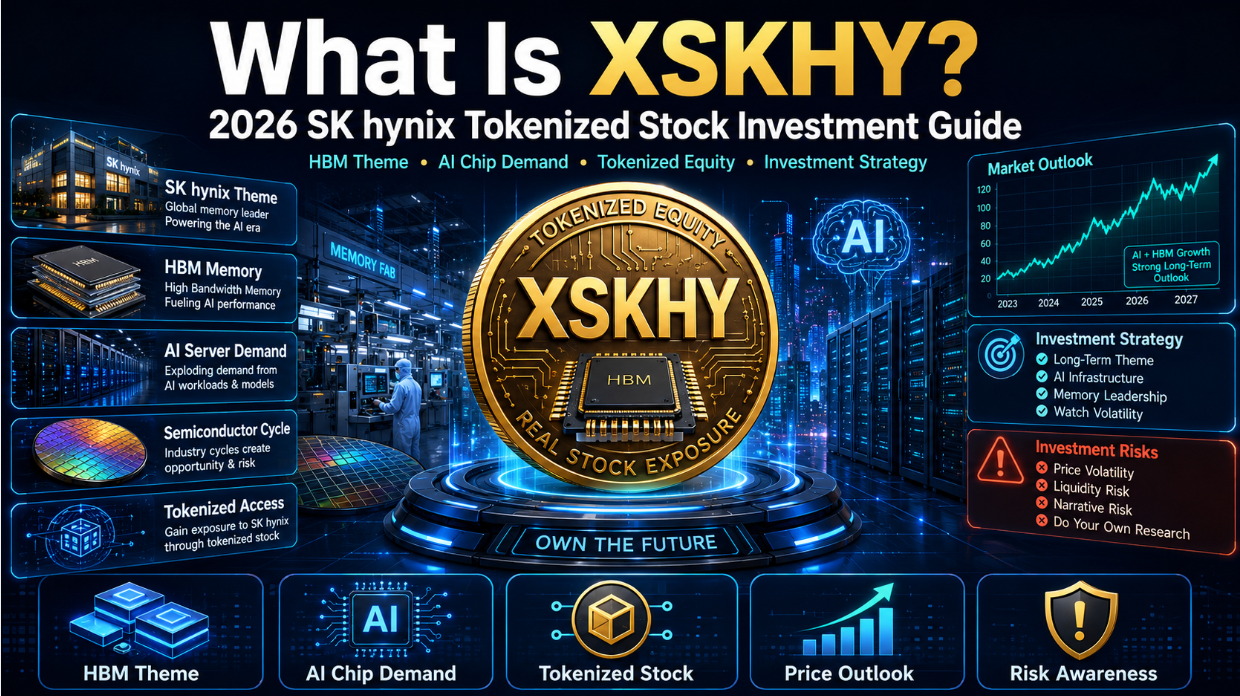
SK Hynix is a South Korean semiconductor company and one of the world’s major memory chip suppliers.
Unlike companies that design CPUs, GPUs, or mobile processors, SK Hynix’s core business is providing data storage and high‑speed memory for servers, PCs, smartphones, data centers, and AI accelerators.
Its main businesses fall into three categories:
- DRAM – working memory for computers, servers, and mobile devices;
- NAND Flash – used in SSDs, mobile devices, and data storage;
- HBM – high‑bandwidth memory for AI GPUs and high‑performance computing.
Don’t oversimplify SK Hynix as just “a memory‑stick company.”
In AI servers, the compute chips handle massive calculations, while high‑performance memory feeds data to those chips quickly. As AI model sizes and compute demands grow, memory bandwidth becomes a critical bottleneck affecting overall system performance.
That’s why SK Hynix has evolved from a traditional memory‑cycle player into a key participant in the AI infrastructure value chain.
Is XSKHY Actually SK Hynix Stock?
XSKHY is price‑linked to SK Hynix stock, but it is not the same as holding SK Hynix common shares directly in a Korean securities account.
Traditional stock ownership typically means you hold company shares through a regulated broker, with corresponding rights under local market rules, such as:
- Voting rights;
- Dividend entitlements;
- Participation in corporate actions;
- Investor protection under specific jurisdictions.
Tokenized stock, by contrast, typically provides price or economic exposure to the underlying stock through an issuer, a legal structure, a custodian, and blockchain tokens.
According to xStocks public materials, the relevant products are described as Tracker Certificates backed 1:1 by the corresponding stock or ETF. That means the token aims to track the economic performance of the underlying security—but it does not automatically grant the same voting rights or shareholder status as common stock.
So a more accurate understanding is:
Buying XSKHY gives you economic exposure to SK Hynix’s price movements, but it should not be understood as holding SK Hynix ordinary shares in Korea’s share registry.
The exact rights depend on the actual issuer, legal documents, custody structure, and the platform’s product terms for XSKHY.
How Does XSKHY Relate to the Publicly Seen Ticker SKHYX?
Investors may come across both XSKHY and SKHYX.
Hibt uses the trading pair code XSKHY/USDT, while xStocks market materials often use SKHYX for SK Hynix‑related xStocks.
Similar tickers do not automatically prove the two assets are identical in all respects.
Different platforms may use different prefixes, suffixes, or internal codes. You should not identify an asset by name alone—always verify:
- Full product name;
- Issuer;
- Underlying security;
- ISIN or other security identifier;
- Blockchain network;
- Token contract address;
- Custodian;
- Proof of reserves;
- Minting and redemption rules;
- Actual rights granted to holders;
- Whether the platform offers only a price‑linked contract.
If Hibt’s XSKHY corresponds to SKHYX within the xStocks ecosystem, the platform’s product documentation and offering documents should clarify that relationship. Without explicit documentation, do not assume equivalence based solely on ticker similarity.
This is one of the most important E‑E‑A‑T boundaries when researching XSKHY.
2. What Are xStocks? How Does XSKHY Track a Real Stock Price?
xStocks is a model that brings the economic value of publicly traded stocks and ETFs onto the blockchain.
According to xStocks public disclosures, each qualifying xStock is backed 1:1 by the corresponding stock or ETF and can be transferred across blockchain wallets, trading platforms, and certain DeFi environments.
The traditional stock investment path is typically:
Open a brokerage account → deposit fiat → buy securities through a stock exchange.
The tokenized stock path can become:
Use USDT or other crypto assets on a crypto platform to buy tokens that are value‑linked to the corresponding stock.
This structure can offer several potential advantages:
- Trade with crypto assets;
- Lower barriers to cross‑market participation;
- Extended trading and transfer windows;
- Tokens can be held in blockchain wallets;
- Composability with DeFi infrastructure;
- An alternative price exposure for users unfamiliar with traditional brokerage systems.
But tokenized stock isn’t just a copy‑paste of a listed company’s ticker onto the blockchain. What actually maintains the token’s price relationship with the underlying security is a complete ecosystem of issuance, custody, market‑making, minting, and redemption.
What Does “1:1 Backing” Mean?
1:1 backing generally means that for each unit of token in circulation, the issuing structure holds a corresponding amount or value of the underlying security.
For example, if an xStock represents the economic value of one share of a specific stock, the issuer or its designated structure is supposed to hold that underlying stock—or establish a corresponding asset‑backing relationship through legal documentation.
This mechanism helps keep the token price tethered to the underlying stock price.
When the token trades significantly above the underlying value, eligible market participants may increase token supply through new issuance, redemption, or arbitrage. When the token trades below, arbitrageurs may buy tokens and redeem them for underlying value.
However, whether ordinary traders can directly participate in minting and redemption—and whether there are minimum amounts, geographic restrictions, or identity requirements—depends on the specific product terms.
Does 1:1 Backing Mean No Risk?
No.
Even if a product claims 1:1 backing by underlying securities, investors still face:
- Issuer risk;
- Custodian risk;
- Asset segregation failure;
- Legal structure risk;
- Reserve transparency risk;
- Minting and redemption restrictions;
- Secondary‑market liquidity risk;
- Token smart‑contract risk;
- Blockchain network risk;
- Platform suspension of deposits or withdrawals;
- Regional regulatory and compliance restrictions;
- The underlying stock’s own price risk.
1:1 backing addresses “whether the token has corresponding assets behind it”—but it does not eliminate all other risks.
Investors should also ask: if the issuer, custodian, or trading platform encounters problems, do you have direct recourse to the underlying securities, and what is your legal standing in a liquidation?
Why Are xStocks Now Focusing on Korean Stocks?
The tokenized stock market initially concentrated on major U.S. tech stocks and ETFs because of their global visibility, deep liquidity, and clear investor demand.
As the RWA (Real‑World Assets) market evolves, tokenization is expanding from U.S. equities to more international markets. In July 2026, xStocks published an international expansion perspective mentioning Hong Kong, the U.K., the EU, and South Korea.
XSKHY thus carries dual significance:
- It offers crypto users price exposure to SK Hynix and the AI‑memory supply chain;
- It represents the expansion of stock tokenization from U.S. assets to Asian listed companies.
Still, “expanding to the Korean market” must be distinguished from the product’s legal issuance jurisdiction, salable regions, and actual underlying securities structure. An asset may circulate on the blockchain, but that doesn’t mean it can be legally offered in all countries.
3. What Does SK Hynix Do, and Why Has the AI Era Changed Its Investment Thesis?
In the past, researching SK Hynix meant focusing on PC, smartphone, server, and enterprise storage demand.
In the AI‑infrastructure expansion phase, HBM has become a key variable affecting SK Hynix’s growth expectations and market valuation.
What Is DRAM?
DRAM stands for Dynamic Random‑Access Memory.
It is the temporary working memory that stores data currently being processed by a CPU or GPU. When a processor executes tasks, it needs fast access to data in DRAM.
DRAM is widely used in:
- PCs;
- Smartphones;
- General‑purpose servers;
- Gaming devices;
- Automotive electronics;
- Data centers;
- AI servers.
DRAM is a highly cyclical, standardized semiconductor product. Small changes in supply or demand can cause noticeable swings in prices and manufacturer profits.
What Is NAND Flash?
NAND Flash is a non‑volatile storage technology that retains data even when power is off. It is primarily used in:
- SSDs;
- Smartphone storage;
- Data‑center storage devices;
- Enterprise storage systems;
- Consumer electronics.
Compared with DRAM, NAND is more about long‑term data retention, but it too has pronounced supply‑demand cycles.
When industry inventories are high, manufacturers over‑expand, or consumer electronics demand weakens, NAND prices can come under pressure, hurting memory‑company earnings.
What Is HBM?
HBM stands for High Bandwidth Memory.
It uses advanced packaging and stacking techniques to deliver much higher data‑transfer bandwidth in a compact footprint, while lowering energy consumption per bit transferred.
AI GPUs need to process massive model parameters and training data simultaneously. If memory bandwidth can’t keep up with GPU compute, even the most powerful GPUs may stall while waiting for data—reducing overall system efficiency.
Think of the GPU as a high‑speed factory, and HBM as the conveyor system that supplies raw materials quickly enough. If the conveyor is too slow, the factory can’t run at full capacity.
That’s why HBM has become an essential component of high‑performance AI accelerators.
Why Do AI Servers Need More High‑Performance Memory?
As AI model sizes and training data continue to grow, we see:
- Larger AI models requiring more data to process;
- AI GPU compute power rising, demanding faster data reads;
- Ordinary memory bandwidth becoming a bottleneck;
- Servers needing more capacity and faster HBM;
- HBM suppliers gaining new growth opportunities.
Beyond AI training, AI inference also boosts memory demand. As more enterprises and users continuously call large models, inference servers must frequently read model parameters and handle high request volumes. The larger the model and the faster the required response, the more critical memory capacity and bandwidth become.
Why Does HBM Command Higher Value?
HBM is generally more difficult to produce than traditional DRAM, requiring complex wafer fabrication, chip stacking, packaging, testing, and yield management.
That means HBM can offer:
- Higher technological barriers;
- Higher value per unit;
- More demanding customer qualification;
- Tighter collaboration with the GPU supply chain;
- More constrained short‑term capacity;
- Relatively higher profit margins.
If SK Hynix can sustain its HBM technology and market‑share advantages, a rising share of premium products could improve its revenue and profit mix.
But high value also attracts competition. Samsung and Micron continue to invest in HBM technology and capacity, so market leadership is not permanent.
4. Why Do NVIDIA, AI Servers, and Data Centers Affect XSKHY Price?
XSKHY’s AI investment logic must be understood through the full industry chain.
Large AI companies, cloud providers, and internet platforms increase AI spending → data centers procure more AI servers → AI servers need GPUs or accelerators from NVIDIA, AMD, etc. → high‑performance GPUs require HBM for fast data → SK Hynix supplies HBM to the GPU chain → HBM orders affect SK Hynix’s revenue, profits, and market expectations → SK Hynix’s stock price moves → that feeds into XSKHY pricing.
Thus, XSKHY has an indirect but clear relationship with the AI industry chain.
What Is the Relationship Between AI GPUs and HBM?
GPUs handle parallel computation; HBM feeds data quickly.
As GPU compute performance improves, the memory subsystem must keep pace. If HBM supply is tight, GPU production and AI server deliveries can be constrained.
When researching XSKHY, investors can monitor:
- New AI GPU launches from NVIDIA and AMD;
- HBM capacity per GPU;
- HBM generation upgrades;
- GPU shipment volumes;
- Key customer qualifications;
- HBM capacity reservations;
- Advanced packaging capacity;
- AI server delivery lead times.
Higher GPU shipments don’t necessarily translate linearly into SK Hynix revenue—you also need to consider HBM capacity per GPU, pricing, SK Hynix’s supply share, and competitor supply.
Why Is XSKHY Not a Substitute for NVIDIA?
NVIDIA and SK Hynix are in the same AI infrastructure chain, but their business models differ.
NVIDIA’s core strengths lie in GPUs, AI computing platforms, CUDA ecosystem, networking, and software.
SK Hynix generates revenue primarily from memory products like DRAM, NAND, and HBM.
NVIDIA captures value from AI compute chips and platforms; SK Hynix benefits more from high‑performance memory demand.
Their risk profiles also differ. NVIDIA faces GPU competition, customer‑designed chips, software‑ecosystem changes, and valuation risk. SK Hynix is more exposed to memory pricing, capacity cycles, yields, HBM market share, and capital expenditure.
Being bullish on AI does not mean NVIDIA and SK Hynix will grow at the same pace, or that their stocks will move in lockstep.
What Happens If AI Capex Declines?
HBM demand depends on AI server and data‑center investment.
If large cloud providers cut AI capital expenditure, the transmission chain could be:
- AI server orders drop;
- GPU purchase expectations weaken;
- HBM demand growth slows;
- Memory manufacturers’ capacity utilization and pricing power decline;
- The market lowers SK Hynix earnings estimates;
- SK Hynix stock and XSKHY come under pressure.
Investors should closely watch hyperscaler capex—investment plans for data centers, AI servers, and networking infrastructure.
But even if capex is still growing, not all supply‑chain companies capture the same profit share—competition, pricing, capacity, and customer mix all matter.
5. Why Is the Memory Cycle More Important Than Just the “AI Narrative”?
AI is a significant growth driver for SK Hynix, but the Memory Cycle remains the foundational variable for company earnings.
If you focus only on HBM growth while ignoring ordinary DRAM, NAND, inventory, and capacity cycles, you may overestimate earnings stability.
What Is the Memory Cycle?
The memory chip industry typically goes through the following cycle:
- Demand increases or supply tightens → DRAM and NAND prices rise;
- Manufacturer profits improve → capital expenditure increases;
- New capacity gradually comes online → supply grows;
- If demand growth can’t keep up, inventories build;
- Memory prices fall → profits compress;
- Companies cut capex and production;
- Supply shrinks again → next price cycle begins.
The memory cycle is rarely driven by a single factor but by a combination of:
- PC demand;
- Smartphone shipments;
- General‑server procurement;
- AI server investment;
- Enterprise inventory levels;
- Chipmaker capacity;
- Process node upgrades;
- Customer forward buying;
- Macroeconomic conditions;
- Capital expenditure.
Why Can SK Hynix’s Profit Volatility Exceed Revenue Volatility?
Memory chip manufacturing requires building fabs, buying equipment, and bearing high fixed R&D and depreciation costs.
When DRAM prices rise, incremental revenue often flows disproportionately to profit—so profit growth can significantly outpace revenue growth.
Conversely, when memory prices fall, fixed costs don’t decline proportionally, so profit margins can shrink quickly—even turning to losses.
So a 10% rise in DRAM prices doesn’t mean SK Hynix’s profit will rise only 10%; profits may show much greater elasticity.
This is why memory stocks can surge during up‑cycles and correct sharply when the cycle turns.
Can HBM Eliminate the Traditional Memory Cycle?
HBM may improve SK Hynix’s product mix, but it cannot fully eliminate cyclical risk.
Positive changes from HBM include:
- Higher share of premium products;
- Higher average selling prices;
- Improved margins;
- Structural AI‑driven demand;
- Longer customer qualification and collaboration cycles;
- Higher technical entry barriers.
But HBM still faces:
- Competitor capacity expansion;
- GPU demand fluctuations;
- Customer concentration;
- Yield variability;
- Technology generation transitions;
- Advanced packaging bottlenecks;
- Price negotiations;
- AI capex cycles.
If all manufacturers aggressively expand HBM capacity based on high demand, and future demand falls short, HBM could also face supply and price pressure.
So “SK Hynix has an HBM advantage” does not mean “SK Hynix is no longer cyclical.”
6. Why Did XSKHY Rise? Don’t Just Look at Crypto Volume
XSKHY price increases can be driven by both the underlying stock and the crypto trading environment.
When analyzing price action, consider six categories of drivers.
SK Hynix Korean Stock Rises
If XSKHY’s product structure indeed tracks the underlying SK Hynix securities, then a rise in SK Hynix’s stock should be the most direct price driver.
Underlying stock gains can come from:
- Earnings beats;
- Earnings estimate upgrades;
- Increased HBM orders;
- Higher DRAM prices;
- Analyst target‑price increases;
- A strong Korean stock market;
- Increased foreign ownership.
Investors should not ignore Korean market price moves just because XSKHY trades on a crypto platform.
HBM Demand Expectations Grow
If AI GPU makers raise shipment forecasts, or next‑gen GPUs require more HBM, the market may raise SK Hynix revenue and profit estimates.
But confirm that demand is translating into real orders—not just market rumors.
DRAM and NAND Enter an Upward Price Cycle
SK Hynix sells not only HBM—ordinary DRAM and NAND still affect overall earnings.
When memory prices rise and industry inventories decline, the company may see both volume and margin improvements.
SK Hynix Earnings Beat Expectations
Key earnings metrics to watch:
- Revenue;
- Operating profit;
- Net income;
- EPS;
- Gross margin;
- HBM revenue;
- DRAM and NAND shipments;
- Average selling prices;
- Next‑quarter guidance;
- Capital expenditure plans.
Markets trade future expectations, not just reported numbers. Even if profit grows, if the growth falls short of prior consensus, the stock and XSKHY may still fall.
NVIDIA and the AI Supply Chain Re‑Rate
When NVIDIA, AMD, data‑center equipment, and the broader semiconductor sector rally, money may simultaneously re‑rate AI supply‑chain companies.
This sector sentiment can lift SK Hynix, but it is a valuation catalyst—not the same as current earnings already having increased.
XSKHY’s Own Liquidity Changes
Tokenized stocks have crypto‑specific secondary‑market factors, such as:
- New users on the platform;
- Influx of USDT liquidity;
- Improved market‑making depth;
- News during stock‑market closure;
- Temporary bid‑ask imbalances;
- Inefficient minting/redemption;
- Price differences between platforms.
Thus, XSKHY’s price does not mechanically copy the Korean stock price at every instant.
To diagnose why XSKHY rose, check the underlying stock, exchange rates, token unit conversion, and secondary‑market premium—not just crypto volume.
7. Why Might XSKHY Deviate from SK Hynix Stock?
Tokenized stocks aim to track underlying value, but “tracking” does not mean identical at every second.
The Korean Stock Market Is Not 24/7
SK Hynix ordinary shares trade during specified hours on the Korean exchange, with weekends, holidays, and scheduled closures.
XSKHY on crypto platforms may offer extended trading hours. While the Korean market is closed, XSKHY can still see trading activity.
This is both a potential advantage of tokenized stocks and a source of price deviation.
What Determines XSKHY Price When the Stock Market Is Closed?
When the underlying stock is closed, short‑term XSKHY price may be influenced by:
- Platform order books;
- USDT liquidity;
- NVIDIA and U.S. semiconductor moves;
- Breaking AI industry news;
- SK Hynix order or product announcements;
- Expectations for the next Korean trading session;
- KRW/USD exchange rates;
- Market‑maker risk controls;
- Prices of similar assets on other platforms.
If major positive or negative news breaks during closure, XSKHY may price it in ahead of the Korean market. When the Korean market reopens, the stock may adjust toward XSKHY—or XSKHY may have over‑priced and revert to underlying value.
What Are Premium and Discount?
Suppose after unit conversion and exchange‑rate adjustment, XSKHY’s underlying reference value is $160, but the platform trades at $166. Then the token has a ~3.75% premium to reference value.
If XSKHY trades at $154, it has a ~3.75% discount.
Actual calculation must also consider:
- Whether the token represents a full share;
- Whether fractional units are used;
- KRW/USD exchange rate;
- Product fees;
- Accrued dividends;
- Market closure times;
- Redemption costs;
- Bid‑ask spreads;
- Data update timing.
Don’t assume SK Hynix fundamentals have improved just because XSKHY is up—the move could simply be an expanding token premium.
Is 24‑Hour Trading an Advantage or a Risk?
It’s both.
Advantage: Investors can adjust positions based on new information during traditional market closures.
Risk: Without real‑time underlying prices, order books may thin, and prices can more easily deviate from reference value.
Therefore, be especially cautious with market orders during closures—check spreads and slippage on larger orders.
8. What Indicators Should You Watch for XSKHY Price Forecasting?
You can refer to XSKHY price prediction for market trends and scenarios.
But for tokenized stocks, using crypto technical indicators alone is insufficient. XSKHY price forecasting requires at least four variable groups.
Group 1: SK Hynix Fundamentals
Key metrics:
- Revenue;
- Operating profit;
- Net income;
- EPS;
- Gross margin;
- HBM revenue;
- HBM revenue mix;
- DRAM and NAND average selling prices;
- Capital expenditure;
- Management guidance.
Compare reported data with market consensus. A 20% earnings increase isn’t necessarily positive if consensus was 30%—the stock may still re‑rate lower.
Group 2: Memory Industry Data
Watch:
- DRAM spot and contract prices;
- NAND prices;
- HBM pricing and orders;
- Industry inventories;
- Customer inventories;
- Wafer capacity;
- Manufacturer capex;
- Capacity utilization;
- Product yields;
- New capacity timelines.
Falling inventories, rising prices, and disciplined capex generally favour a memory‑cycle recovery. If prices rise and manufacturers quickly add capacity, assess future supply pressure.
Group 3: AI Industry Data
Focus on:
- AI server shipments;
- GPU orders;
- Hyperscaler capex;
- NVIDIA and AMD product cycles;
- HBM capacity per AI accelerator;
- AI training and inference demand;
- Data‑center power and construction constraints;
- Customer‑developed AI chips.
AI demand growth is a key HBM driver, but distinguish between short‑term bulk purchases and sustainable long‑term demand.
Group 4: Valuation and Token Pricing
Don’t just ask whether XSKHY can reach $100 or $200.
Instead, assess:
- SK Hynix’s current P/E;
- Cycle‑adjusted earnings;
- Price‑to‑book;
- EV/CF;
- Valuation relative to Samsung, Micron, etc.;
- How much HBM growth is already priced in;
- Whether XSKHY trades at a premium to the underlying;
- Whether token liquidity supports current price.
If SK Hynix earnings are strong but the stock has already priced in even higher growth, XSKHY could still fall—even on good results.
9. XSKHY Investment Strategies: Different Timeframes, Different Indicators
Different investment horizons cannot use the same decision rules.
Short‑Term Traders: Trade Events and Price Deviations
Short‑term traders focus on:
- SK Hynix earnings;
- NVIDIA earnings;
- HBM orders and customer qualifications;
- DRAM price moves;
- Korean market open;
- KRW/USD;
- XSKHY volume;
- Order‑book depth;
- Premium/discount;
- News during stock‑market closures.
Core short‑term mindset:
Don’t use a long‑term AI growth story as a reason to chase short‑term rallies.
A company may have a bright long‑term outlook, but that doesn’t mean every price ahead of earnings is a good entry.
Pre‑set:
- Maximum acceptable loss;
- Price levels that invalidate your thesis;
- Planned holding period;
- Whether to trade during closures;
- Slippage tolerance;
- Whether to stop chasing if premiums become excessive.
Swing Traders: Focus on the Memory Cycle
Swing traders are better served by studying:
- How memory‑price changes affect next‑stage earnings expectations;
- How those expectation adjustments drive stock valuation.
When DRAM and NAND inventories fall, prices recover, and HBM demand remains strong, SK Hynix may benefit from both the traditional memory cycle and AI structural growth.
But if the stock has already rallied significantly, swing traders must also assess whether valuation already reflects a cycle peak.
Memory stocks typically peak before earnings actually top, and may start pricing the next recovery while current earnings are still poor. So looking at current profits alone is insufficient.
Long‑Term Investors: Bet on Structural AI Memory Growth
Long‑term investors care less about any single earnings report and more about whether these trends persist:
- AI model size expansion;
- AI inference demand growth;
- Higher memory capacity per AI server;
- HBM penetration rising;
- SK Hynix maintaining technological competitiveness;
- Stable HBM market share;
- Improving margins on premium products;
- Disciplined capex from management;
- Cash‑flow resilience through downturns.
Long‑term investment logic cannot be simplified to “AI will grow, so XSKHY will rise.”
The AI industry may keep growing, but supply‑chain competition, overvaluation, and memory over‑expansion could still produce below‑expected returns.
10. When Does XSKHY Deserve More Attention? When Should You Wait?
This article cannot replace individual investment decisions, but it can offer a judgment framework that doesn’t rely on hype.
Relatively Favourable Environment
The fundamental backdrop may be more constructive when:
- HBM orders and demand estimates are consistently raised;
- AI server shipments remain strong;
- DRAM is in an upward price cycle;
- Industry inventories are declining;
- SK Hynix earnings estimates keep rising;
- HBM market share holds steady;
- Gross margins and cash flow improve;
- Valuation is not obviously stretched;
- XSKHY trades without a severe premium to reference value;
- The token market has sufficient depth.
Even if these conditions hold, prices can still fall—entry price and position sizing still matter.
Cautious Environment
Raise risk awareness when:
- SK Hynix has rallied sharply and valuation expands rapidly;
- Market expectations clearly exceed the company’s own guidance;
- HBM pricing or order expectations weaken;
- Samsung or Micron narrow the technology gap;
- Major cloud providers slow AI capex;
- DRAM inventories start rising;
- Memory manufacturers collectively expand capacity;
- KRW/USD moves sharply;
- XSKHY trading depth declines;
- XSKHY trades at a noticeable premium to the underlying;
- Token price is pumped by short‑term money during closures.
Even with solid fundamentals, not every price is worth buying.
Why Consider a Phased Approach?
Tokenized stocks are influenced by both equity and crypto markets, so prices can swing sharply around earnings, industry data, and market closures.
A phased strategy can include:
- Establishing a small observation position;
- Adding only after fundamentals confirm the thesis;
- Re‑examining reasons when prices pull back;
- Updating earnings estimates after reports;
- Adjusting positions when the memory cycle shifts;
- Pausing chasing if the token premium becomes excessive.
Dollar‑cost averaging does not eliminate losses, but it avoids concentrated exposure at a single point in time. However, if a pullback stems from deteriorating fundamentals—not just sentiment—mechanical buying may amplify losses. So “buy the dip” is not a substitute for fresh research.
11. What Are the Biggest Risks of Investing in XSKHY?
XSKHY carries not only SK Hynix stock risk but also additional risks from the tokenized‑stock structure.
SK Hynix Share Price Decline
If the underlying stock falls due to earnings deterioration, valuation compression, or a weaker industry cycle, XSKHY generally cannot rise independently for long. Tokenization does not change the underlying company’s profitability.
HBM Competition Risk
SK Hynix faces competitors like Samsung and Micron. They may:
- Improve HBM yields;
- Gain qualification with major GPU customers;
- Expand capacity;
- Launch next‑gen products;
- Compete on price;
- Strengthen advanced‑packaging collaborations.
That could gradually narrow the technology and market‑share gap.
AI Capex Cooling Risk
If large tech companies find AI investment returns below expectations, they may reduce GPU and data‑center procurement. That would hit HBM demand expectations and could compress SK Hynix’s valuation.
Memory Cycle Reversal Risk
A drop in DRAM and NAND prices can significantly compress profits. HBM growth may not fully offset the cyclical pressure from traditional memory businesses.
Korean Market and Currency Risk
SK Hynix is listed in Korea, so its valuation can be affected by:
- Korean macroeconomic conditions;
- Korean equity risk appetite;
- Foreign capital flows;
- KRW/USD exchange rate;
- Interest rates;
- Corporate governance discounts;
- Geopolitics;
- Semiconductor export policies.
If XSKHY is priced in USDT, you also need to consider the FX impact when converting KRW‑denominated stock prices to USD value.
Tokenized‑Stock Structural Risk
Tokens are not ordinary shares in a securities account.
You may not have the same voting rights, direct shareholder status, dividend treatment, or investor protection.
The exact rights are governed by the legal documents and platform terms.
Issuer and Custodian Risk
Even with a 1:1 backing claim, verify:
- Who holds the underlying stock;
- Whether assets are segregated from the issuer’s own assets;
- Whether reserves are audited;
- What happens in issuer bankruptcy;
- Whether users can redeem;
- Which users are eligible for redemption;
- How to seek recourse if the custodian fails.
Liquidity and Premium/Discount Risk
XSKHY trading volume may be lower than the underlying stock. With a thinner order book, larger orders can incur significant slippage. During stock‑market closures, premiums or discounts may widen further.
Platform and Blockchain Risks
Users also face:
- Exchange operational risk;
- Suspension of deposits/withdrawals;
- Account security issues;
- Token contract vulnerabilities;
- Blockchain congestion;
- Sending to the wrong network;
- Counterfeit tokens;
- Exchange delisting.
Regulatory and Geographic Restrictions
Tokenized stocks implicate both securities and crypto regulations. Different countries may impose different requirements on issuance, trading, marketing, investor eligibility, and KYC. A product tradable today may see service regions or product structures change in the future.
12. How to Buy XSKHY – Using Hibt’s XSKHY/USDT as an Example
XSKHY/USDT means using USDT as the quote asset to trade XSKHY.
Basic process:
Register or Log In to Hibt
Create an account, complete security verification, and pass the platform’s identity authentication. Enable two‑factor authentication and never share your password, verification code, or private keys.
Prepare USDT
Obtain USDT through the platform’s supported methods, or deposit from other wallets/exchanges.
Before depositing, verify:
- Deposit network;
- Address;
- Minimum deposit amount;
- Platform network status;
- Whether a memo/tag is required.
Using the wrong network may result in lost funds.
Search for XSKHY/USDT
Navigate to the trading section and search for XSKHY or XSKHY/USDT.
You can also use the XSKHY real‑time quote page to see current price and trading data.
Check XSKHY Market Depth
Before placing an order, review:
- Best bid and ask;
- Bid‑ask spread;
- 24‑hour volume;
- Order‑book depth;
- Expected slippage;
- Whether the underlying stock is currently open.
A rising token price does not guarantee you can sell large size at that price—your actual exit capacity depends on bid depth.
Compare Against SK Hynix Underlying Reference Value
This is one of the biggest differences between trading tokenized stocks and ordinary crypto tokens.
Before buying, check:
- Latest SK Hynix stock price;
- KRW/USD exchange rate;
- Token‑to‑stock unit ratio;
- Whether XSKHY is at a premium or discount;
- Whether the underlying market is closed;
- Whether the current move is driven by news during closure.
Without confirming unit conversion and underlying correspondence, you cannot accurately judge whether XSKHY is deviating from reference value.
Choose Limit or Market Order
Limit orders let you set a price but don’t guarantee execution.
Market orders fill faster but may incur slippage. Use market orders with particular caution during low‑liquidity periods or when the underlying stock is closed.
Before trading, re‑verify XSKHY’s product description, issuance structure, and network—don’t rely solely on the token name to confirm authenticity.
13. How Does XSKHY Differ from SPYON and SOXLON?
Not all RWA and tokenized‑stock products carry the same risk. Classify by underlying asset rather than treating all USDT‑traded assets as equivalent.
XSKHY vs. SPYON: Single Company vs. Broad‑Market ETF
What is SPYON USDT describes tokenized assets linked to the S&P 500 ETF.
XSKHY is concentrated on:
- A single company (SK Hynix);
- The semiconductor industry;
- HBM;
- DRAM and NAND;
- The AI server supply chain;
- The Korean market.
SPYON provides broader exposure to U.S. large‑caps, with more diversification across sectors and companies.
XSKHY may offer higher upside potential but also carries greater company‑specific risk, memory‑cycle risk, and HBM competition risk. SPYON is more diversified, but still faces U.S. equity valuation, macroeconomic, and tokenized‑asset structural risks.
Disclaimer: This article is based on publicly available information for educational and reference purposes only. It does not constitute investment advice, an offer, or a solicitation. Cryptocurrencies are high‑risk assets with significant price volatility. Please do your own research (DYOR) before making any decisions and comply with the laws and regulations of your jurisdiction.
XSKHY vs. SOXLON: A Memory Company vs. a Leveraged Semiconductor Sector Asset
What is SOXLON USDT corresponds to assets linked to a semiconductor sector leveraged ETF.
XSKHY concentrates on SK Hynix’s company fundamentals.
SOXLON reflects the leveraged performance of the broader semiconductor sector, which may include GPUs, CPUs, equipment, foundries, analog chips, and other semiconductor names.
The differences are not just “one company vs. an industry”—they also include the leverage structure.
Leveraged ETFs typically have daily reset, volatility drag, and path dependency. Even if the semiconductor sector rises over the long term, the actual return of a leveraged product held for extended periods may not equal a fixed multiple of the index’s cumulative return.
So being bullish on AI chips doesn’t mean you must invest in just one chip company; being bullish on the semiconductor sector doesn’t mean leveraged products are suitable for long‑term holding.
XSKHY vs. CBRSON: Tech Cycle vs. Consumer Defensives
What is CBRSON USDT covers the tokenized logic of traditional consumer retail assets like Carrefour.
XSKHY is primarily influenced by:
- AI capex;
- Semiconductor cycles;
- HBM demand;
- Memory pricing;
- Technology competition.
CBRSON is more driven by:
- Consumer demand;
- Retail margins;
- Food prices;
- The European economy;
- Store efficiency;
- Defensive consumption.
Both may trade on crypto platforms, but the underlying businesses and risk drivers are completely different.
That’s why asset allocation matters: investors should not ignore industry correlations just because multiple assets trade against USDT.
14. Why Might BTC and ETH Still Affect XSKHY?
In theory, XSKHY’s primary fundamentals come from SK Hynix—not Bitcoin or Ethereum.
A BTC rally does not directly increase SK Hynix’s HBM orders, nor does it automatically lift the company’s operating profit.
But because XSKHY trades on crypto platforms, BTC and ETH can still have indirect effects through:
- The scale of USDT liquidity;
- Crypto investor risk appetite;
- Platform trading activity;
- Tokenized‑stock liquidity;
- Bid‑ask spreads;
- Secondary‑market premiums;
- Overall deleveraging behaviour by investors.
When crypto markets enter a risk‑on phase, investors may be more willing to trade RWAs and stock‑linked tokens. During sharp market declines, users may simultaneously sell crypto assets and tokenized stocks to raise USDT liquidity.
You can reference BTC price prediction and market cycles to gauge whether risk appetite is expanding or contracting.
You can also combine ETH price prediction and Ethereum trends to observe on‑chain finance and overall RWA market activity.
But crucially:
BTC and ETH are trading‑environment variables for XSKHY, not core fundamental variables for SK Hynix.
For XSKHY’s long‑term value, company earnings, HBM demand, memory cycles, and stock valuations remain more important.
15. Is XSKHY Worth Investing In? Use Seven Metrics Instead of a Simple Yes/No
Whether XSKHY is worth investing in cannot be answered by AI hype, token price, or recent gains alone.
Build a seven‑point observation framework.
1. Is HBM Demand Growing Sustainably?
Track AI GPU shipments, HBM capacity per GPU, next‑gen HBM products, customer orders, and data‑center investment.
2. Which Phase of the DRAM Cycle Are We In?
Assess industry inventories, pricing, capacity, and capex. If the market is approaching rapid supply expansion, even strong current profits warrant caution about the next cycle pressure.
3. Is SK Hynix’s Profitability Improving Sustainably?
Look at EPS, operating profit, gross margin, free cash flow, and management guidance—not just revenue growth.
4. Are Hyperscalers Continuing to Increase AI Capex?
Ultimate demand for AI servers largely comes from cloud and tech company investment. Distinguish between one‑time procurement and a sustained structural trend.
5. Are Samsung and Micron Closing the HBM Gap?
Part of SK Hynix’s valuation premium comes from market expectations of its HBM competitiveness. If competitors gain more qualifications, improve yields, or expand market share, the valuation may be re‑assessed.
6. Is SK Hynix’s Current Valuation Reasonable?
A great company can still be a poor investment at too high a price. Judge current price against cycle‑adjusted earnings, historical valuations, and future growth expectations.
7. Is XSKHY Deviating from Its Underlying Reference Value?
Even if you’re bullish on SK Hynix, a severe premium of XSKHY to the underlying stock could expose you to additional mean‑reversion risk.
Ultimately, form a five‑layer decision model:
Company fundamentals × AI cycle × Memory cycle × Stock valuation × Token pricing.
A material change in any layer can affect XSKHY investment outcomes.
16. XSKHY Frequently Asked Questions
What Is XSKHY?
XSKHY is a SK Hynix‑linked tokenized asset traded as USDT pairs on crypto platforms. Its primary value logic derives from SK Hynix stock and company fundamentals.
What Is XSKHY USDT?
XSKHY/USDT is the trading pair where USDT is used as the quote and settlement asset. Traders can buy and sell XSKHY using USDT.
Is XSKHY a Cryptocurrency?
XSKHY uses tokens and crypto trading infrastructure, but its economic value points to SK Hynix stock exposure—it should not be understood as an independent crypto project token.
What Is the Relationship Between XSKHY and SK Hynix?
XSKHY aims to provide economic exposure linked to SK Hynix’s share price. The exact ratio, issuance structure, and holder rights must be confirmed from the product’s formal documentation.
What Is the Difference Between XSKHY and SKHYX?
XSKHY is the trading code used by Hibt, while SKHYX may appear in xStocks market materials. Do not assume they are identical based solely on ticker similarity—verify issuer, underlying security, contract address, and product description.
Does Buying XSKHY Equal Buying SK Hynix Stock?
Not exactly. Buying XSKHY gives you economic exposure related to SK Hynix’s price, but it does not mean you are registered as a common shareholder in the Korean securities system.
Does XSKHY Have Shareholder Voting Rights?
Tokenized stocks generally do not automatically grant the same voting rights as traditional common stock. Specific rights depend on the XSKHY issuance documents and platform terms.
Why Did XSKHY Rise?
Possible reasons include a rise in SK Hynix stock, higher HBM demand, DRAM price recovery, earnings beats, AI sector valuation expansion, and changes in XSKHY’s own liquidity or premium.
Is XSKHY Worth Investing In?
You need to evaluate SK Hynix fundamentals, HBM competitiveness, the memory cycle, AI capex, stock valuation, and XSKHY’s pricing deviation from the underlying asset.
Is XSKHY Suitable for Long‑Term Holding?
Long‑term value depends primarily on whether SK Hynix can sustain HBM competitiveness, improve earnings, and manage cyclical risk. You also need to continually assess the token issuance, custody, and regulatory structures.
What Determines XSKHY’s Price?
Primarily determined by SK Hynix stock price, exchange rates, token unit conversion, market liquidity, and premium/discount.
Can XSKHY Be Traded 24/7?
Whether 24‑hour trading is supported depends on the specific platform rules. Even if a platform offers extended hours, the Korean stock market has fixed trading sessions, and price deviations may widen during closures.
Which Is Better, XSKHY or SOXLON?
There is no universal answer. XSKHY is concentrated on a single company (SK Hynix), while SOXLON is more about a leveraged semiconductor sector ETF. The former has company‑specific risk; the latter carries leverage reset and volatility‑drag risks.
Why Does SK Hynix Benefit from AI?
AI GPUs require high‑capacity, high‑bandwidth memory. SK Hynix is a major HBM supplier, so AI server and data‑center growth can boost demand for its products.
What Is HBM?
HBM stands for High Bandwidth Memory. It provides higher data‑transfer speeds for AI GPUs and high‑performance computing systems.
What Are the Biggest Investment Risks of XSKHY?
Major risks include SK Hynix share price decline, HBM competition, AI capex slowdown, memory‑cycle reversal, currency fluctuations, token issuance and custody risks, and secondary‑market premium/discount and liquidity insufficiency.
17. Conclusion: Investing in XSKHY Is Essentially a Bet on How Much High‑End Memory the AI Era Will Need
On the surface, XSKHY is an RWA or stock‑linked token tradable on crypto platforms—but its long‑term value core still comes from SK Hynix’s earning power.
The full fundamental transmission chain is:
AI training and inference demand grows → cloud providers and data centers increase AI server investment → AI servers procure more GPUs and accelerators → high‑performance GPUs need larger‑capacity, higher‑bandwidth HBM → SK Hynix secures orders through its products, capacity, and customer relationships → HBM and DRAM demand affect revenue, margins, and cash flow → the market re‑values SK Hynix based on future earnings → underlying stock price and token pricing mechanics ultimately influence XSKHY price.
But this value chain is not one‑way or guaranteed.
AI capex could slow, competitors could narrow the technology gap, memory makers could over‑expand, and DRAM prices could enter another down‑cycle.
Even if SK Hynix’s fundamentals remain solid, if the stock has priced in overly high growth expectations, XSKHY could still correct.
At the same time, XSKHY investors bear additional risks from the issuer, underlying custody, legal structure, trading platform, liquidity, and premium/discount.
Therefore, investing in XSKHY should not use the same methods as analyzing a meme coin, nor rely solely on crypto technical indicators.
A more robust research framework is:
Semiconductor company fundamentals + AI industry cycle + memory chip cycle + RWA pricing mechanics.
Ultimately, the questions you need to answer are not “Does XSKHY carry AI and RWA labels?”
They are:
- Can SK Hynix maintain its HBM competitiveness in the AI era?
- How much high‑end memory will future AI servers require?
- Are those growth expectations already fully reflected in the stock valuation?
- Does XSKHY’s current price accurately reflect the underlying asset value?
Only by verifying each of these questions can you objectively judge whether XSKHY fits your investment horizon, risk tolerance, and asset‑allocation goals.