
The internet is undergoing its most significant transformation yet. We are moving beyond the era of centralized platforms into Web3, a new phase of the internet built on decentralization, transparency, and user empowerment. Web3 technology is not just an incremental update; it is a fundamental re-architecting of how we interact, transact, and own our digital lives. For everyone in Vietnam, from seasoned investors to individuals just starting their crypto journey, understanding how to leverage this technology is essential for navigating the future of the digital economy.
This comprehensive guide will walk you through the practical steps to harness the power of Web3 technology. We will explore its core components, identify actionable strategies for participation, and examine real-world case studies that showcase its transformative potential. By the end, you will have a clear roadmap for engaging with this new technological frontier and seizing the opportunities it presents.
What is Web3 Technology and Why Is It a Game-Changer?
To leverage Web3, you first need to understand what it is. At its core, Web3 technology shifts control from large corporations to individual users. Unlike Web2, where a few tech giants own the platforms and control the data, Web3 is built on decentralized networks, primarily blockchain. This creates an internet that is open, trustless, and permissionless.
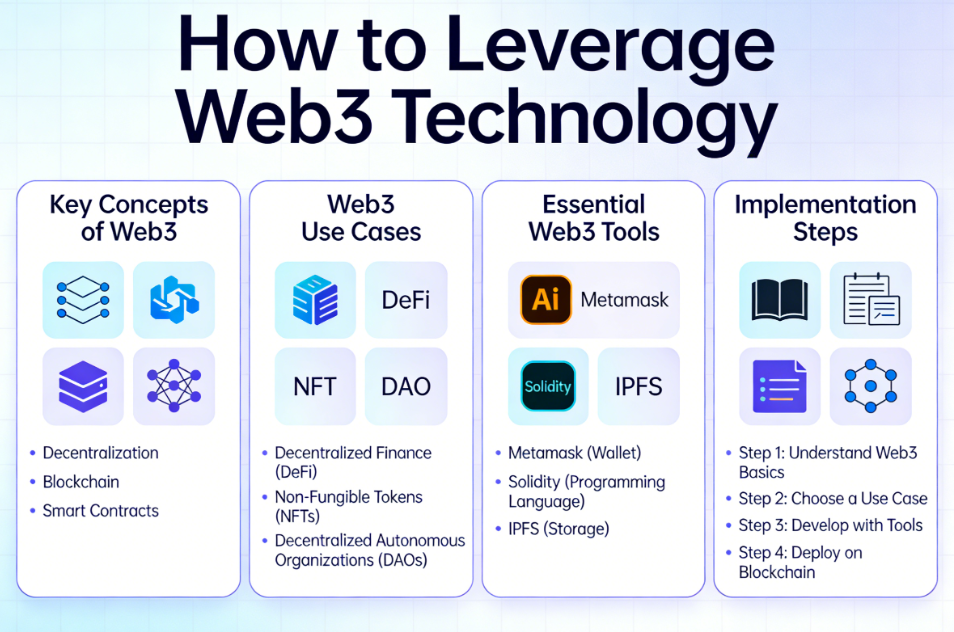
The key pillars of Web3 technology include:
- Blockchain: A distributed, immutable ledger that records transactions securely and transparently. It is the foundational layer that enables decentralization.
- Cryptocurrencies: Digital or virtual tokens that use cryptography for security. They serve as the native currency for Web3 ecosystems, facilitating transactions and incentivizing participation.
- Smart Contracts: Self-executing contracts with the terms of the agreement directly written into code. They automate processes and eliminate the need for intermediaries.
- Decentralized Applications (dApps): Applications that run on a peer-to-peer network of computers rather than a single server. They are censorship-resistant and give users full control over their data.
The significance of this shift cannot be overstated. Web3 technology empowers individuals with true ownership of their digital assets and identity. It fosters innovation by allowing anyone to build and participate without seeking permission from a central authority. For investors and users in Vietnam, this opens up a world of new financial products, creative economies, and more equitable digital experiences.
Step 1: Educate Yourself on the Web3 Ecosystem
The first and most crucial step in leveraging Web3 technology is to build a solid foundation of knowledge. The space is complex and evolves rapidly, so continuous learning is non-negotiable.
Understanding the Layers of Web3
Think of Web3 as a stack of technologies built on top of each other.
- Layer 1 (The Blockchain Layer): This is the base layer, the blockchain itself (e.g., Ethereum, Solana, Bitcoin). These networks provide the fundamental security and consensus for the entire ecosystem. Understanding the differences between blockchains—such as their consensus mechanisms (Proof-of-Work vs. Proof-of-Stake), scalability, and transaction fees—is critical.
- Layer 2 (The Scaling Layer): These are protocols built on top of Layer 1 blockchains to improve scalability and reduce costs (e.g., Polygon, Arbitrum). They process transactions off the main chain, making dApps faster and more affordable for everyday use.
- Layer 3 (The Application Layer): This is where you find the user-facing dApps. This includes decentralized finance (DeFi) platforms, NFT marketplaces, blockchain games (GameFi), and social media platforms. This is the layer most users will interact with directly.
Follow Reputable Sources
Stay informed by following trusted news outlets, industry leaders on social media, and educational platforms. For Web3 technology in Vietnam, look for local communities and thought leaders who can provide context relevant to the regional market. Podcasts, newsletters, and online courses are excellent resources for deepening your understanding.
Step 2: Set Up Your Web3 Wallet
Your gateway to the decentralized web is a Web3 wallet. Unlike a traditional bank account, a Web3 wallet gives you sole custody of your assets. You are in complete control of your private keys, which means no one can access your funds without your permission.
Choosing the Right Wallet
There are several types of wallets, each with different security and convenience trade-offs:
- Software Wallets (Hot Wallets): These are applications that run on your computer or smartphone (e.g., MetaMask, Phantom). They are convenient for frequent transactions but are connected to the internet, making them more vulnerable to hacking.
- Hardware Wallets (Cold Wallets): These are physical devices that store your private keys offline (e.g., Ledger, Trezor). They offer the highest level of security and are ideal for storing large amounts of cryptocurrency long-term.
As a best practice, many users employ a combination of both: a hardware wallet for secure storage and a software wallet for daily interactions with dApps.
Securing Your Wallet
When you set up a wallet, you will be given a seed phrase (or recovery phrase), typically 12 or 24 words long. This phrase is the master key to your wallet. If you lose your device, you can use the seed phrase to restore your wallet and access your funds.
It is absolutely critical to secure your seed phrase.
- Write it down on paper and store it in a safe, secure location.
- Never store it digitally (e.g., in a text file, email, or cloud storage).
- Never share it with anyone. Anyone with your seed phrase can steal your assets.
Step 3: Acquire Your First Digital Assets
Once your wallet is set up, you need to fund it with cryptocurrency. This will be your currency for interacting with the Web3 ecosystem—paying transaction fees (known as "gas"), buying NFTs, and investing in DeFi protocols.
Using a Cryptocurrency Exchange
The easiest way to buy crypto is through a centralized exchange (CEX). These platforms allow you to buy cryptocurrencies using fiat currency (like the Vietnamese Đồng). When choosing an exchange, prioritize security, user-friendliness, and a wide selection of assets.
For users in Vietnam, a platform like HIBT provides a secure and intuitive entry point. It offers a simple interface for beginners to purchase major cryptocurrencies like Bitcoin (BTC) and Ethereum (ETH), while also providing advanced trading tools for experienced investors. The platform’s commitment to security ensures your assets are protected as you begin your Web3 journey.
Transferring to Your Personal Wallet
After purchasing crypto on an exchange, it is best practice to transfer it to your personal Web3 wallet. This moves the assets from the exchange's custody into your own, giving you full control. The process is simple: just copy your wallet's public address and use it as the destination for the withdrawal on the exchange. Always double-check the address before confirming the transaction.
Step 4: Explore Decentralized Applications (dApps)
With a funded wallet, you can now start exploring the vast world of dApps. This is where you truly begin to leverage Web3 technology.
Decentralized Finance (DeFi)
DeFi aims to rebuild the entire traditional financial system on the blockchain, without intermediaries. You can lend, borrow, trade, and earn interest on your assets, all through smart contracts.
- Decentralized Exchanges (DEXs): Platforms like Uniswap or PancakeSwap allow you to trade cryptocurrencies directly from your wallet. Unlike centralized exchanges, you never give up custody of your funds.
- Lending and Borrowing: Protocols like Aave and Compound let you deposit your crypto to earn interest or use it as collateral to borrow other assets. This is a powerful tool for generating passive income or accessing liquidity without selling your holdings.
- Yield Farming and Staking: These are more advanced strategies where you provide liquidity to DeFi protocols in exchange for rewards. Staking also plays a crucial role in securing many blockchain networks.
Case Study: Earning Passive Income with DeFi
An investor in Ho Chi Minh City wants to earn a better return on her savings than a traditional bank can offer. She learns about DeFi and decides to explore stablecoin lending. She converts some of her savings into USDT (a stablecoin pegged to the US dollar) on an exchange like HIBT.
She then transfers the USDT to her MetaMask wallet and connects to the Aave protocol. She deposits her USDT into Aave's lending pool. Immediately, she starts earning a variable interest rate, paid out in real-time. The interest comes from other users who are borrowing USDT from the pool. She can track her earnings and withdraw her funds at any time. By leveraging DeFi, she has turned her static savings into a productive asset generating passive income. This is a primary example of how to use Web3 for crypto beginners to access new financial opportunities.
Non-Fungible Tokens (NFTs)
NFTs are unique digital tokens that represent ownership of an item, whether it's art, music, a collectible, or even virtual real estate. They have created new economies for creators and collectors.
- NFT Marketplaces: Platforms like OpenSea and Magic Eden are where you can buy, sell, and mint NFTs.
- Utility NFTs: Beyond digital art, many NFTs come with utility. This could be access to an exclusive community, tickets to an event, or special abilities in a blockchain game.
GameFi and the Metaverse
GameFi, or blockchain gaming, combines gaming with financial incentives. The "play-to-earn" model allows players to earn real-world value (in the form of crypto or NFTs) through their in-game activities. The success of Axie Infinity, a project with deep roots in Vietnam, is a testament to the power of this model.
The metaverse refers to persistent, shared virtual spaces where users can interact with each other and with digital objects. These worlds are increasingly being built on Web3 technology, with land, avatars, and in-world items represented as NFTs.
Step 5: Develop Your Web3 Investment Strategy
Leveraging Web3 technology also means developing a sound investment strategy. The space is volatile, so a disciplined approach is crucial.
Diversification is Key
Do not put all your capital into a single project or sector. A well-diversified portfolio might include:
- Blue-Chip Cryptocurrencies: Established assets like Bitcoin (BTC) and Ethereum (ETH) that form a stable foundation.
- Layer 1 and Layer 2 Tokens: Investing in the native tokens of promising blockchains is a bet on the growth of their entire ecosystem.
- DeFi and dApp Tokens: Higher-risk, higher-reward investments in specific applications you believe have long-term potential.
- NFTs and Digital Collectibles: A more speculative but potentially lucrative part of your portfolio.
For traders looking to build and manage a diversified portfolio, a reliable platform is essential. HIBT offers a wide range of assets, from major cryptocurrencies to emerging altcoins, providing the tools needed to execute sophisticated Web3 investment strategies.
Research and Due Diligence (DYOR)
The most important rule in crypto is "Do Your Own Research" (DYOR). Before investing in any project, conduct thorough due diligence.
- Read the Whitepaper: This document outlines the project's goals, technology, and tokenomics.
- Evaluate the Team: Who are the founders and developers? Do they have a proven track record?
- Assess the Community: A strong, active, and engaged community is often a sign of a healthy project. Check their Discord, Telegram, and social media channels.
- Analyze Tokenomics: How is the token distributed? Is there a fixed supply? High inflation or a large allocation to the team can be red flags.
Case Study: Analyzing a New Web3 Project
A seasoned investor in Hanoi hears about a new Layer 1 blockchain project focused on decentralized social media. Instead of investing based on hype, she follows a rigorous research process.
- She reads the whitepaper to understand the technology. She notes that it uses a novel consensus mechanism designed for high throughput and low fees, which is ideal for social media applications.
- She researches the team and finds that the founders are experienced software engineers from top tech companies and have published academic papers on distributed systems.
- She joins the project's Discord channel. She observes active discussions among developers and community members, with the team regularly answering questions and providing updates.
- She analyzes the tokenomics. She sees that a significant portion of the tokens is allocated to community rewards and ecosystem development, with a reasonable vesting schedule for team and investor tokens.
Based on this comprehensive research, she decides to make a small initial investment. She sets clear profit targets and stop-losses, managing her risk effectively. This disciplined approach is how professional investors leverage Web3 technology to identify promising opportunities while mitigating risk.
Conclusion: Your Future in the Decentralized Web
Web3 technology is more than just a new set of tools; it represents a new philosophy for the internet—one built on ownership, decentralization, and community. Leveraging this technology requires a commitment to education, a focus on security, and a strategic approach to participation and investment.
By following the steps outlined in this guide—educating yourself, setting up a secure wallet, exploring dApps, and developing a thoughtful investment strategy—you can confidently navigate this exciting new landscape. For everyone in Vietnam, from beginners taking their first step into crypto to experienced traders looking for the next wave of innovation, the opportunities are immense. The future of the internet is being built today, and with a trusted partner like HIBT, you have everything you need to be a part of it.
About the Author
Dr. Bao Nguyen is a distinguished expert in cryptographic protocols and decentralized network architecture. He has authored over 60 peer-reviewed papers in the field of blockchain security and has been a keynote speaker at major international technology conferences. Dr. Nguyen has led the formal security audits for several of the world's leading Layer 1 blockchain projects, ensuring the robustness and safety of their core infrastructure. He is a strong proponent of digital sovereignty and is committed to making Web3 technology accessible to a global audience.